Justine Carrelli: The American Bandstand Dancer Whose Image Outlasted the Spotlight
She used her sister’s birth certificate to get into Studio B at age twelve. Decades later, a stranger who had watched her dance on television came back to find her — and married her.
A Nation Learning to Watch Itself
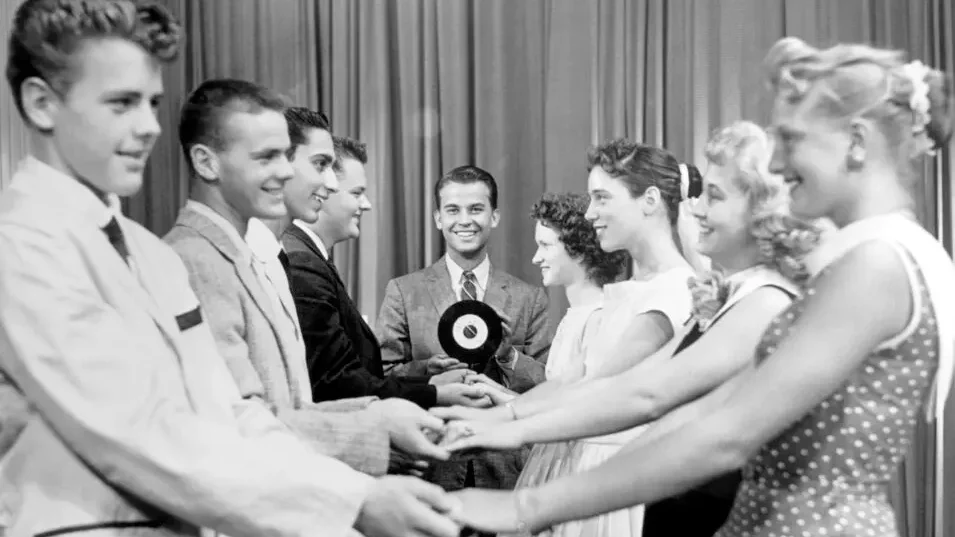
Evoking the spirit of American Bandstand’s early Philadelphia years — a studio floor alive with teenage dancers under television lights, circa 1957
In the late summer of 1957, something quiet and extraordinary happened inside American living rooms. A local Philadelphia television program called Bandstand moved onto the ABC national network, renamed American Bandstand, and within weeks an estimated twenty million viewers were tuning in each afternoon to watch teenagers dance. They were not watching celebrities. They were watching kids — from row houses in Southwest Philly, from Catholic high schools and public school corridors — move across a studio floor to the sound of records that parents found unsettling and children found necessary.
The show had existed since 1952, first under host Bob Horn, broadcast regionally on WFIL-TV to the Delaware Valley. It was a local institution before it became a national one. Dick Clark, twenty-six years old and carefully groomed, took over as host in 1956 and spent a year convincing ABC the format could travel. It could. Viewers watching American Bandstand were not just watching other people’s children. They were watching a version of themselves, or the version they wished they could be.
Among those dancers, one face became especially familiar. Her name was Justine Carrelli, and she was twelve years old when she first walked into Studio B in 1956 — two years younger than the rules allowed, and one year before the show carried her image to the entire country.
The Girl in the Spotlight
What viewers saw when they looked at Justine Carrelli was a particular kind of American girl: composed without being cold, pretty without being untouchable. She wore her hair in careful waves — other girls across the country pressed their own hair into pin curls overnight, trying to replicate the look. She moved with an ease that suggested she had always known how to dance, which was not quite true. She had walked into something she could not believe, she would say later. The lights, the music, the electricity of it all. She had wanted it immediately.
By 1957, when American Bandstand went national, Carrelli had become a Regular — one of the small group of teenagers granted status within the show’s careful social architecture. The Committee system, overseen by producer Tony Mammarella, sorted dancers into tiers. Regulars did not wait in the long lines that stretched outside the WFIL studios on Market Street. They arrived, were recognized, and walked through. In exchange, they submitted to dress codes, behavioral standards, and the unspoken understanding that their presence served the program, not the other way around.
Carrelli’s visibility on the show grew steadily, and with it came the particular strangeness of being known by strangers. Fan mail arrived. A magazine noted her birthday. When Dick Clark asked on air whether she collected anything — she said she liked dolls — hundreds of dolls arrived at the studio within days, sent by viewers she had never met. The image television had constructed of her was already operating independently, gathering its own momentum.
Her partnership with Bob Clayton, a tall, confident young man who drove thirty-two miles from Wilmington, Delaware each afternoon to be on the show, became the emotional center of what viewers watched. He had seen her on television before he ever met her. He had driven north, walked into the studio, and told her she was going to be his girl. She had refused him, watched him dance with someone else, and then changed her mind. They won the first national jitterbug contest together in 1957, receiving over a million votes cast by mail. America had chosen them.
Southwest Philadelphia, Before the Cameras
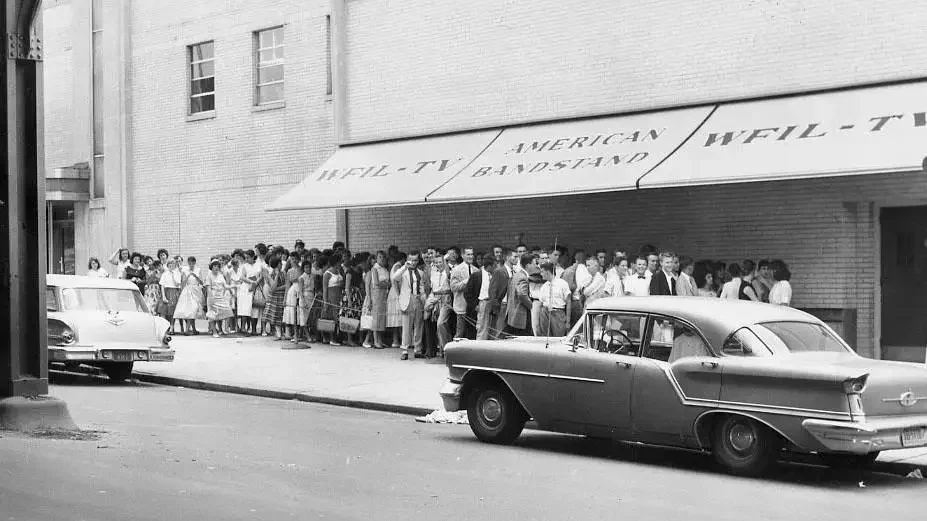
A visual recreation of the WFIL studio entrance on Market Street in Philadelphia — the door through which a generation of teenagers passed, identity cards in hand.
The story of how Justine Carrelli came to stand in front of those cameras begins, like most stories, in the ordinary textures of a childhood. She grew up in Southwest Philadelphia, in a neighborhood of row houses and Catholic schools and street corners where teenagers congregated in the years before malls existed. Her father was John Carrelli. Her mother, also named Justine, worked as a nurse — a detail that would carry a quiet symmetry decades later, when her daughter was admitted to Penn Presbyterian Hospital, the same system where her mother had worked.
The first time Carrelli tried to enter the Bandstand studio, she was turned away. She did not look fourteen, the officer at the door told her. She went home. Her mother suggested she bring her older sister’s birth certificate the next day. She did. She got in.
The decision was small, practical, and entirely reasonable by the standards of a twelve-year-old who wanted to dance. But it was also the first act in a longer story about image and identity — about who gets seen, and under what circumstances. Carrelli entered American Bandstand as someone she was not quite yet, documented by a piece of paper that belonged to someone else. Television would spend the next several years constructing a version of her that millions of people would carry in their memories long after she herself had moved on.
The studio itself was a world with strict rules. Tony Mammarella walked the floor with safety pins in his pocket. Dick Clark monitored the exits. The Regulars understood, without being told explicitly, that their access depended on their compliance. They were not stars. They were not paid. They were teenagers who had been permitted inside, and the permission could be revoked.
The Height of a Manufactured Sweetness
The years between 1957 and 1960 were, by any measure, the peak of what Justine Carrelli’s image could do without her. She appeared on the cover of Teen magazine in March 1960. Photoplay ran a layout from a party the magazine threw for her sixteenth birthday in 1958. She and Bob Clayton were written about in newspapers and teen publications as though their relationship were a matter of national concern — which, in a modest way, it was. They had been voted into existence as a couple by a million strangers. Their chemistry on the dance floor had been selected, amplified, and broadcast into homes from Philadelphia to Los Angeles.
What the cameras could not capture, and what no magazine layout could convey, was the extent to which Carrelli was navigating all of this at fifteen, sixteen, seventeen years old. She was visible to millions of people who felt they knew her. She was, at the same time, a teenager from Southwest Philadelphia who was still figuring out what she wanted.
The relationship with Clayton was real, whatever its origins in the television apparatus. She had genuine feelings for him. He had driven thirty-two miles every afternoon for years. But the show had also shaped how they experienced each other — the spotlight dances, Dick Clark’s interviews, the constant sense of being observed. When the relationship eventually ended, Carrelli would say simply that Clayton had developed a roaming eye. He agreed, more or less. They were outgrowing each other. The cameras had held them together longer than they might have stayed otherwise.
The end came not through any personal decision but through an institutional one. Carrelli and Clayton mentioned, on air or in conversation with producers, that they were interested in recording a single. The record — titled Drive-In Movie — was cut. It was released, and it failed. More consequentially, it violated Dick Clark’s iron rule: the dancers on his floor were amateurs, and the moment they became professionals, they were gone. Clayton had already aged out. Carrelli had not. She was removed from the show.
“I thought my life was over,” she said later.
What the Camera Left Behind

Dolan Springs, Arizona — where Justine Carrelli built her later life, far from the studio lights of Philadelphia.
The removal from American Bandstand was, in the structure of Carrelli’s life, a turning point — but not in the direction the phrase usually implies. It did not end anything that mattered. It ended only the arrangement by which her image had been rented to a television program in exchange for a kind of visibility that she had never quite controlled.
What followed was a life that the cameras never saw, and that no fan magazine ever described. She completed high school. She worked as a steno typist for the Marine Corps. She modeled. She took voice lessons. She got a job singing with a band called The Paul Dino Review, performing on both coasts. The bandleader, Paul Dino Bertuccini, had appeared on Bandstand himself — his song Ginnie Bell had reached the top forty in 1961, and he had met Carrelli during a winter broadcast when the show was conducted outside in the snow. She married him. They had two sons, Paul and John. They moved to Las Vegas, where Paul Dino’s group performed regularly at the Fremont Hotel. She was a backup singer, a dancer, a wife, a mother.
The marriage lasted fifteen years and then ended. There were other chapters: a second marriage to another musician, a screenplay she wrote about her Bandstand years titled It Wasn’t All Dancing, a real estate license, an office at Wishing Well Realty in Dolan Springs, Arizona — a small town in the high desert with a population of fewer than two thousand people.
None of this appeared on any television screen. None of it was visible to the million people who had once voted for her and Bob Clayton in a dance contest. The image they held of her — the girl with the careful waves, dancing in a Philadelphia studio — remained fixed while she kept moving.
The Man Who Watched the Screen
In 2012, a man named Jim Miller, recently retired and living in Venice, Florida, found himself thinking about Justine Carrelli. He had been thinking about her, off and on, for most of his life. He had first seen her on American Bandstand as a junior high school student on Long Island, and he had been, in his own words, smitten. He had no illusions about it: she was in the same category as Marilyn Monroe, an image on a screen, unreachable. He had watched the show when she was on it and done something else when she was not.
Dick Clark died in April 2012. The news brought Carrelli back to Miller’s mind with unusual force. He typed her name into a search engine.
He found her. She was selling real estate in Dolan Springs, Arizona.
He called. She called back, thinking he might be a buyer. He explained who he was — a fan, he said carefully, someone who had watched her dance. He asked if she might have lunch with him on his way through Arizona. She said yes. She had met other fans over the years, she said. But not usually for lunch.
He was surprised, when they met, by how short she was. She was surprised by how easily they talked. He went back to his hotel and called her again that evening. They had lunch a second day. She mentioned Hawaii was on her bucket list. He was planning a trip to Hawaii with family that spring, he said. She told him to count her in.
They married in 2014. Both had said they would never marry again.
“He still treats me like I’m the queen of the hop,” she said, years later.
A Life That Continued
Justine Carrelli spent her final years dividing her time between Dolan Springs and Venice, Florida, with her husband Jim. She remained a talented sketch artist. She could style hair with professional precision. She stayed in contact with Dick Clark’s world until his death, seeing him and his wife socially in Las Vegas during the decades when her Paul Dino chapter had placed her in that city. She attended the Bandstand Diaries book launch in 2016, standing in what had once been Studio B at the Enterprise Center in Philadelphia, the building where she had first walked in with her sister’s birth certificate more than sixty years earlier.
She died on May 24, 2023, at seventy-nine, after being diagnosed with an aortic aneurysm while visiting her sister in Philadelphia. She was admitted to Penn Presbyterian Hospital — the same hospital system where her mother had worked as a nurse, a few blocks from where American Bandstand had once been produced. She is survived by her husband Jim Miller, her sons Paul and John Bertuccini, her grandchildren Christina and Ava Rose, and her sister Mary.
What the Screen Kept
There is something worth pausing over in the fact that Jim Miller found Justine Carrelli through a search engine in 2012 — that the image American Bandstand had made of her was still retrievable, still circulating, still capable of reaching across decades into a man’s retirement and rearranging his plans.
Television, in the late 1950s, was new enough that no one had thought carefully about what it would mean to fix a teenager’s image at a specific moment and distribute it to twenty million households. The teenagers on American Bandstand did not sign contracts about the afterlife of their visibility. They came to dance, and the cameras recorded them, and the recordings outlasted everything else.
Justine Carrelli went on to build several lives after Studio B: a performer’s life, a domestic life, a professional life, a quiet life in the desert. She wrote a screenplay about the experience she had left behind. She found her way, eventually, to a late and unexpectedly tender happiness. The girl in the careful waves kept moving. The image stayed where it was, waiting for whoever came looking.
What Arlene Sullivan Was Really Hiding Behind Those Perfect Dance Steps
American Bandstand’s Pat Molittieri: The Girl Who Invented a Dance and Paid Everything for It
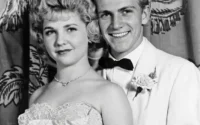
Bob Clayton and Justine Carrelli: American Bandstand’s Sweethearts — Did They Ever Marry?
About The Author

Arthur Pendleton
A lifelong fan of the golden era of music, dedicated to preserving the timeless memories and stories of American Bandstand.