What Arlene Sullivan Was Really Hiding Behind Those Perfect Dance Steps
She received five hundred fan letters a week. She danced every weekday on national television. And for years, nobody — not the cameras, not the audience, not Dick Clark — saw what was actually happening.
A Girl on a Bus, a City on a Screen
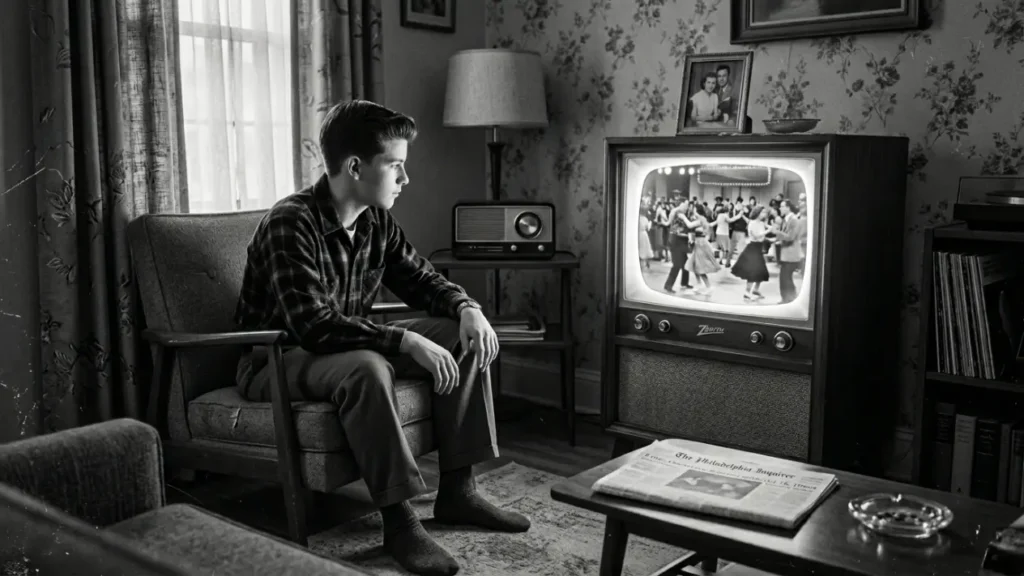
On a weekday afternoon in the autumn of 1958, a fifteen-year-old girl in a full skirt and saddle shoes stepped off a trolley car on Market Street in West Philadelphia. School had let out at 2:15. She had perhaps forty-five minutes to get to the studio. Her hair was set. Her shoes were clean. She did not think of herself as a performer. She thought of herself as a girl who wanted her mother to look up from whatever she was doing and see her — really see her — on the television screen.
The building she was walking toward, WFIL-TV at 4548 Market Street, housed a studio smaller than it looked on camera. But what it broadcast was vast. Every weekday afternoon from 2:30 to 5 o’clock, American Bandstand sent the image of Philadelphia’s teenagers into living rooms across the country — into forty-five states, eventually, reaching an audience that would grow to twenty million. For the kids inside Studio B, it was an after-school activity. They danced, went home for dinner, did their homework. Their parents always knew where they were.
For the country watching, it was something else entirely: the first sustained, daily image of American youth in motion. Not performing. Not auditioning. Simply existing — under studio lights, in front of cameras, being looked at. The girl getting off the trolley that afternoon was Arlene Sullivan. She did not yet understand what was about to happen to her. In that gap between what she thought she was doing and what the country saw, something remarkable was taking place.
The Machine That Made Them Famous
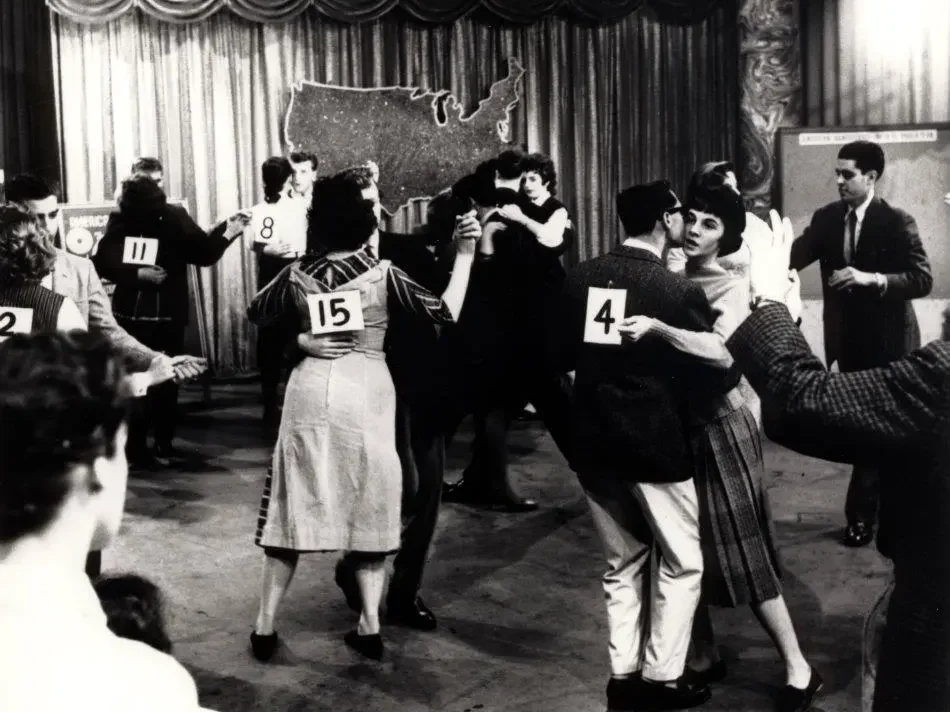
American Bandstand worked because it looked effortless. That appearance required considerable engineering. When the program went national on August 5, 1957, it launched across sixty-seven affiliate stations simultaneously — a logistical achievement that the show’s casual, sock-hop atmosphere was designed to obscure. Dick Clark, then twenty-seven, understood something that the television industry was still learning: that the camera did not simply record youth. It constructed it.
The mechanics were precise. Every teenager who wanted to appear on camera needed a WFIL-TV Bandstand Club membership card — a system that created a defined class of participants called the Regulars, distinct from the ordinary crowd that filled the bleachers. The Regulars knew where the cameras were. Arlene Sullivan, by her own admission, knew exactly where to position herself. So did the others. The dance floor became a kind of choreographed spontaneity, a space where genuine feeling and production strategy occupied the same square footage.
Control was exercised quietly. When the Regulars drifted too close to the cameras — jostling, as Arlene later recalled, to “strut our stuff in front of America” — Clark would use the studio microphone to push them back. “You’d be dancing,” remembered Kenny Rossi, “and all of a sudden you’d hear Dick’s voice telling you to drop back to the rear.” The instruction came without drama, woven into the rhythm of the afternoon. The show felt free. It was not free.
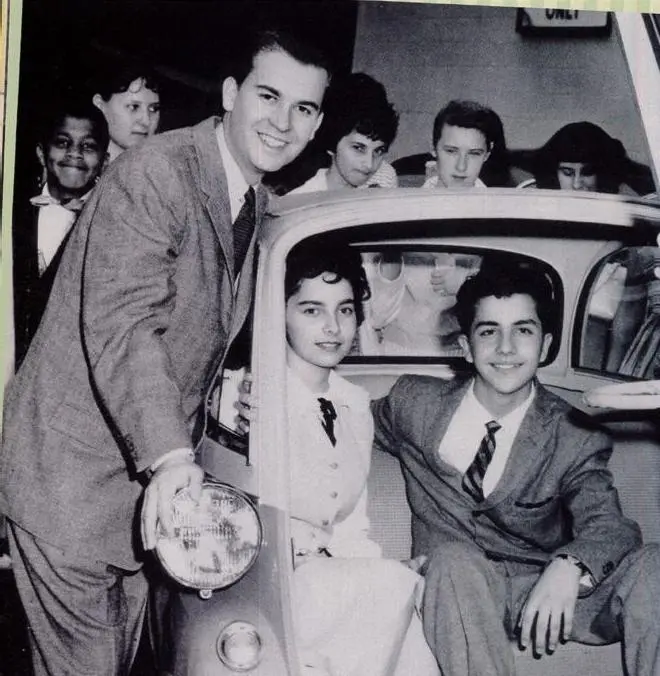
What the program did with Arlene Sullivan illustrates how celebrity was manufactured in this new medium. Fan letters began arriving. Clark noticed. He started interviewing her on air. More letters came. When Clark produced his first film and held a viewer contest to choose four girls for a cameo, Arlene was one of the four selected. The audience had been given the experience of choosing her. In practice, the system had been working toward that result all along. She had been made famous by a machine that looked like a dance floor.
What the Camera Produced
The social consequences of this machinery were neither planned nor incidental. They emerged from the collision between what the show was built to do — sell records, sell products, reassure parents — and what it actually created when twenty million people watched the same teenagers every afternoon.
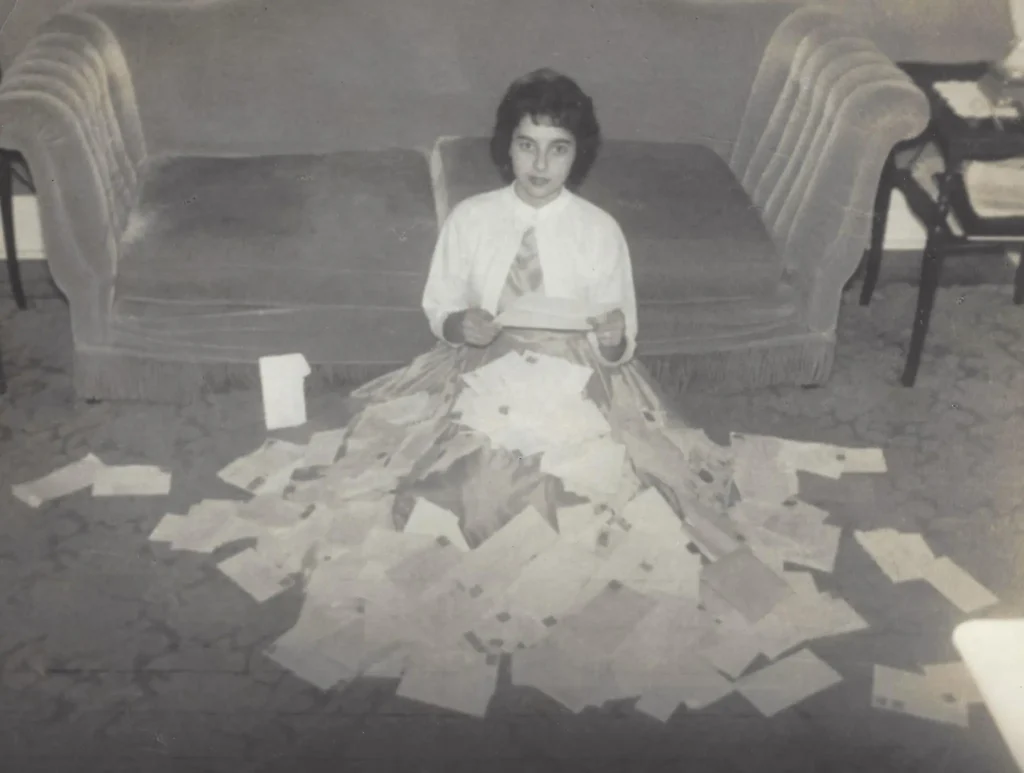
What it created, above all, was a new category of person: the ordinary celebrity. Arlene Sullivan was not the best dancer on the floor. She was not, by her own assessment, the most attractive girl in the studio. “I wasn’t a great dancer, I wasn’t a fashion plate, I wasn’t the prettiest girl there,” she said, decades later, still sounding slightly puzzled. “I don’t really know what it was.” And yet the letters arrived — five hundred a week at the height of her partnership with Kenny Rossi — from teenagers across the country who had made her theirs.
The show offered something the existing celebrity economy did not: proximity. Vera Badamo, who grew up in Brooklyn in the 1950s, remembered the specific pleasure of coming home each afternoon and seeing “Italian kids, just like me” on the national screen. Arlene Sullivan — dark-complexioned, South Philadelphia, half-Irish and half-Italian — carried that recognition for a particular segment of the audience. She was them, and they were her.
Consider, alongside her, Myrna Horowitz. Horowitz wore a leg brace, the residue of childhood polio. She had no regular dance partner. She was not, by conventional television logic, someone the camera should favor. Her parents had feared she would be ridiculed. Instead, when she underwent leg surgery and was bedridden for sixteen weeks, Dick Clark reported updates on her recovery to his national audience. Viewers wrote. They worried. They cared. The show had convinced them that these were their children — not performers, but neighbors, glimpsed through a window that happened to be a television screen.
The nine billion dollars in annual teenage spending that advertisers had identified by the late 1950s flowed through this tender relationship. The Regulars were, without contracts or compensation, the most effective product endorsers in America. Their clothes were copied. Their dances were copied. Their relationships — who was dancing with whom, who had a steady — were followed with the attention that an earlier generation had given to radio serials.
What the Camera Could Not See
There is a version of the American Bandstand story that is entirely cheerful: teenagers dancing, a nation watching, a generation finding its image and recognizing itself. That version is true. It is also incomplete.
The contradiction at the center of the show was this: it celebrated youth while controlling it absolutely. It broadcast spontaneity that was rehearsed, captured authenticity that was curated, and presented freedom within a framework of rules so thorough that the teenagers themselves often did not recognize them as rules at all. Boys wore jackets and ties. Girls wore nothing tight. The dress code was enforced not as censorship — it was framed as courtesy, as appropriate self-presentation, as the reasonable expectations of a family program.
The deeper control was less visible. Dick Clark promoted couples — Arlene and Kenny, Bob and Justine, the paired dancers who became the show’s emotional architecture — in part because couples were legible and reassuring to a national audience. The pairing also served another function, one that went unacknowledged for decades. Several of the Regulars, including Arlene Sullivan herself, were gay. The couples format ensured that this remained invisible. As Arlene would write plainly in her memoir, she was dancing with Kenny Rossi while privately navigating an emerging identity that the show’s entire visual grammar was designed to conceal. She was not alone.
The experience of being banned makes the power structure momentarily visible. At some point in her tenure, Clark summoned Arlene and a group of fellow seventeen-year-olds into a room and informed them they were no longer permitted on the show. No reason was given. Arlene, years later, would describe it as a “McCarthy-like experience” — a phrase that locates the incident precisely within the anxieties of its historical moment, when suspicion without explanation was a recognized instrument of social management.
Even America’s sweethearts were subject to the gap between image and reality. Bob Clayton and Justine Carrelli, the couple most identified with the show’s romantic promise, were genuinely in love and genuinely volatile. Justine eventually ended it because Bob had, in his own words, “a roaming eye.” The camera had seen two teenagers in perfect synchrony. It had not seen the arguments, the jealousy, the ordinary mess of being seventeen and in public.
The Architecture That Remained
The Regulars of American Bandstand were, as the book documenting their era would later observe, the nation’s first reality television stars. They received thousands of fan letters. They were recognized on the street. Their fashions were imitated in cities where no one had ever been to Philadelphia. And then, when they turned eighteen, they disappeared from the screen — absorbed back into ordinary life with a completeness that the culture had not prepared them for, or their audiences.
What did not disappear was the structure. The specific innovation of Bandstand — that ordinary young people, framed and watched and made to represent something larger than themselves, could generate the emotional intensity previously reserved for trained performers — proved to be one of the durable discoveries of twentieth-century media. The format that followed, in different technological iterations, preserved the essential architecture: ordinary youth made visible, then made meaningful, then made valuable to advertisers who understood that identification was more powerful than aspiration.
The question Arlene Sullivan could not answer — “I don’t really know what it was” — is the same question that has not been satisfactorily answered about any subsequent version of this phenomenon. What the audience wanted from her was not perfection. It was recognition. The camera found in her something the audience already contained, and reflected it back with the authority of a national broadcast.
What Remains in the Light
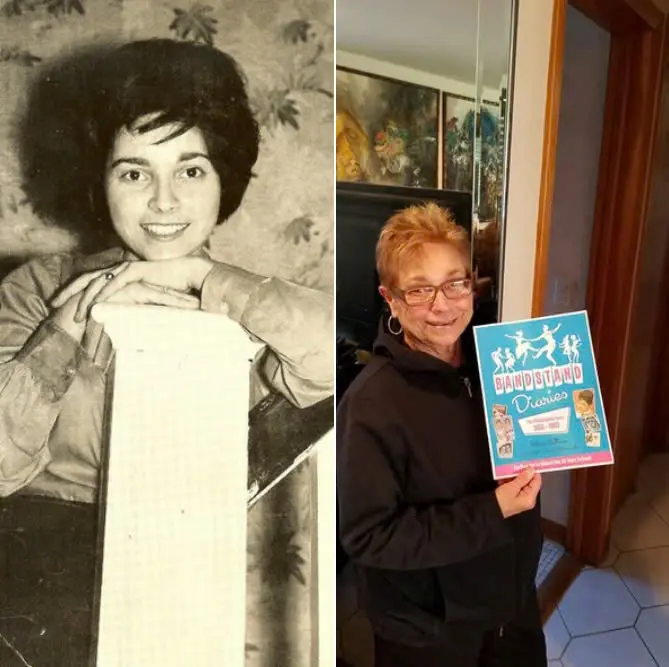
She still dances. Arlene Sullivan, decades removed from the girl on the trolley car, has said it simply: as long as she is walking, she will continue. The dancing was always hers, even when it belonged, for a few extraordinary years, to twenty million strangers.
The footage remains, too. Black and white, slightly grainy, the edges of the frame softened by time and poor preservation. A girl in a full skirt, moving across a studio floor under lights that have long since gone dark. She is fifteen, or sixteen, or seventeen, depending on the reel. She does not look at the camera directly — she knows where it is, but she has learned to pretend she doesn’t. This was part of the skill the show required: to be watched without appearing to perform being watched.
What she was hiding — from the camera, from the audience, from herself in some measure — would take years to fully surface. The image the country fell in love with was real and partial in equal proportion, which is perhaps all that any image, broadcast or otherwise, can honestly claim to be. The dance floor preserved a version of her. The rest of her life was lived elsewhere, in the ordinary passage of time that television cannot follow and does not try to.
Love this memory? Support our archive with a small donation to help us keep these golden days alive forever.
Bob Clayton and Justine Carrelli: American Bandstand’s Sweethearts — Did They Ever Marry?
American Bandstand’s Pat Molittieri: The Girl Who Invented a Dance and Paid Everything for It
Justine Carrelli: The American Bandstand Dancer Whose Image Outlasted the Spotlight
About The Author

Arthur Pendleton
A lifelong fan of the golden era of music, dedicated to preserving the timeless memories and stories of American Bandstand.