American Bandstand’s Pat Molittieri: The Girl Who Invented a Dance and Paid Everything for It
For two years, Pat Molittieri danced on American Bandstand and a nation watched. Then she dared to own her own name — and that was the end of it.
When America Learned to Watch Its Young
In the late summer of 1957, something quiet and irreversible was happening inside American living rooms. Television sets — boxy, flickering, smelling faintly of warm plastic — had become the new center of domestic life. By that year, nearly forty million households owned one. Suburban neighborhoods from Pennsylvania to California had rearranged their furniture around the screen, and the screen, in turn, had begun rearranging American culture.

Saturday afternoon in South Philadelphia, 1957 — a neighborhood where teenagers walked to the studio and danced their way onto a national stage.
Rock and roll was barely two years old as a national phenomenon, but it had already unsettled the generation that came before. Parents heard it as noise. Teenagers heard it as permission. And on the afternoon of August 5, 1957, a teenage dance program based in Philadelphia began broadcasting across sixty-seven stations — a moment that would permanently alter how America understood its own youth.
American Bandstand arrived not with fanfare but with a familiar rhythm: a studio floor, a stack of 45s, and a group of teenagers from South Philadelphia who danced every weekday afternoon as naturally as they breathed. Among them was a fourteen-year-old girl from Passyunk Avenue named Pat Molittieri. She was five feet three inches tall, with dark brown hair and eyes to match, and a kind of physical exuberance that seemed to exceed the frame of any television screen. She wasn’t performing. She was simply — undeniably — herself.
She did not know, that summer, what visibility would cost her. Few of them did.
A Girl from Passyunk Avenue Steps Into the Frame
Pat Molittieri grew up in a tight-knit Italian American household on Passyunk Avenue, in a part of Philadelphia where neighbors knew each other’s business and family names carried weight. Her father Frank drove a bus. Her mother Adele kept the home. There was a younger brother, Frank Jr., and the particular texture of working-class Catholic Philadelphia — block parties, church on Sundays, and the kind of communal life that would soon be mythologized as the American Bandstand teenagers carried it onto national television.
She attended John Bartram High School, the same school that produced several of the program’s early regulars. Dancing wasn’t a pursuit for Pat — it was simply what teenagers in her neighborhood did, the way they inhabited their bodies and their Friday nights. When American Bandstand first went national, the teenagers who showed up to Studio B on Market Street were not auditioning for fame. They were coming to dance after school, the way they always had, only now sixty-seven television stations were watching.
What the national audience saw, almost immediately, was Pat.
Her version of the bop — the dominant dance of the era — was distinctly her own. Where other dancers refined their movements, Pat added something almost percussive: a bounce, a rhythmic punctuation that turned a standard step into something recognizable from across a room. By some accounts, she is credited with originating a variation called the Hop, threading together elements of the Slop and the Bop into something that spread to dance floors across the country within months.
This was the peculiar alchemy of American Bandstand at its peak. A fourteen-year-old girl from Southwest Philadelphia could invent a dance step on a Tuesday afternoon, and by Thursday it would be practiced in basements in Ohio and California. The teenagers on the show were, without fully understanding it, cultural transmitters — carrying Philadelphia’s particular flavor of rock-and-roll movement into millions of homes that had never heard of Passyunk Avenue.
The program was, in the language of the era, a phenomenon. Fifteen thousand fan letters arrived each week. Sponsors lined up. Dick Clark, who had taken over as host in 1956, understood instinctively that what he had was not merely a television program but a marketplace for youth — its music, its fashions, its desires, and its faces. The teenagers on the floor were both participants and products, though most of them had no framework for understanding the second part of that equation.
Pat Molittieri had a national fan club before she turned fifteen.
What the Camera Did Not Show
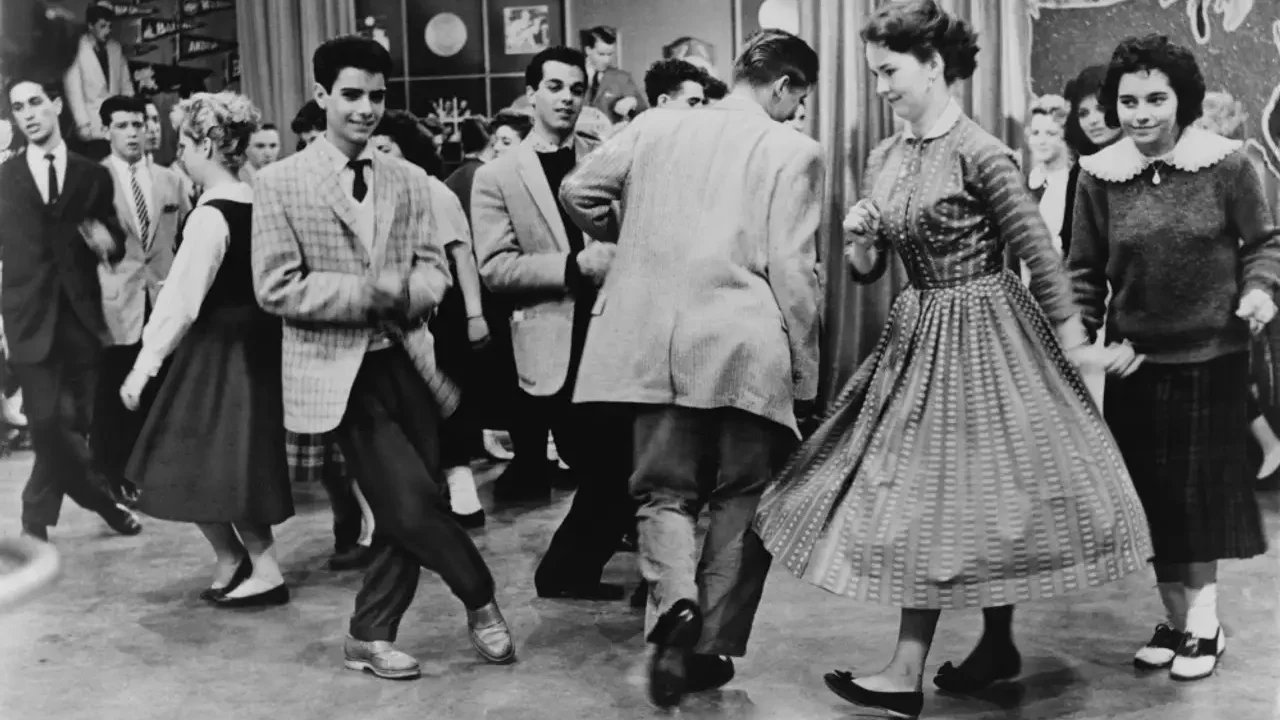
Studio B on Market Street — the polished floors, the careful fashions, and the teenagers who made a nation feel young again.
Television, in its early years, carried a particular paradox: it made people visible while simultaneously reducing them to image. What appeared on screen was never simply life — it was life that had been selected, framed, lit, and broadcast. American Bandstand was no exception.
The program operated under what insiders called the Committee system — a rotating group of regulars who were given consistent access to the floor in exchange for reliable, camera-friendly behavior. Dress codes were enforced at the door. Jeans were not permitted. Girls wore skirts and blouses; boys wore collared shirts and sport jackets. The implicit contract was clear: you could dance however you liked, but you would look the way America expected teenagers to look.
Dick Clark ran this arrangement with the precision of someone who understood that perception was the product. The teenagers who appeared on screen represented a particular version of youth — energetic, wholesome, attractive, and, crucially, non-threatening to the parents who also watched. Race operated quietly within this curation: the show was technically integrated, but the visible couples, the regulars who received the most screen time, were predominantly white, a reflection of both the network’s calculations and the social pressures of the era.
For Pat, as for most of the regulars, the structure felt like belonging rather than constraint. She was seen. She was known. The studio floor on Market Street was as close to a second home as any institution in her young life. She danced with Lou Solino, a South Philly regular whose quiet reliability complemented her energy, and with Bill Ettinger, with whom she performed the push — a close-contact dance that required the kind of casual physical trust that teenagers in 1957 were only permitted to display on television because it looked so entirely innocent.
What the camera showed was genuine. What it didn’t show was the machinery around it: the coordinators who managed the crowd, the dress code enforcers at the entrance, the producer’s eye that decided which faces lingered in the frame. American Bandstand was a real place where real teenagers danced to real music. It was also, simultaneously, a carefully managed representation of what postwar America wanted its teenagers to be.
Pat Molittieri moved through both realities at once, belonging entirely to neither.
The Weight of Being Loved by Strangers
By late 1958, Pat Molittieri was receiving more fan mail than almost any dancer on the floor. The letters came from across the country — from girls who practiced her bounce in their bedroom mirrors, from boys who wrote in careful cursive about watching her every afternoon, from adults who found something in her uncomplicated joy that the rest of television could not provide.
She was, in the language of the era’s teen magazines, a Regular — the term used for the dancers who returned week after week and became familiar to a national audience. The word carried more weight than its simplicity suggested. Regulars were not celebrities in any traditional sense. They received no salary. They signed no contracts. They were, technically, amateur teenagers who happened to dance in front of cameras. And yet the machinery of teen culture — the fan magazines, the fan clubs, the letters, the recognition on the street — treated them with a seriousness usually reserved for recording artists.
This was new territory, historically. The postwar youth market had created an economy built around teenage desire: their music, their fashions, their faces. American Bandstand was both a product of that economy and one of its primary engines. When a girl like Pat became a recognizable face on the program, she entered a system that had uses for her image even as it denied her any formal stake in it.
In the latter months of 1958, Pat began writing a column for Teen Magazine. Charles Laufer, the magazine’s founder, recognized what the Bandstand audience represented and offered Pat a platform — and a modest payment — to share her observations about life on the show. Her columns were light, warm, full of the specific details that readers wanted: fashion notes, behind-the-scenes anecdotes, the texture of afternoons at Studio B. Girls across the country read them as dispatches from a world they could almost imagine belonging to.
Pat was sixteen years old, writing professionally, and — though no one used the word yet — building a personal brand.
Dick Clark found out about the arrangement in the spring of 1959.
The Loneliest Day
The collision that ended Pat Molittieri’s time on American Bandstand was not dramatic in the way that collisions between individuals and institutions often appear in retrospect. It was, by all accounts, a quiet conversation in a television studio on an ordinary afternoon in Philadelphia. But its implications spread outward into cultural territory that neither Pat nor Clark could have fully mapped in the moment.
Clark’s rule was unambiguous: the amateur dancers on his program were not to profit from their Bandstand exposure. The show had made them visible; the visibility belonged to the show. It was an arrangement that suited the program’s interests and the network’s interests, and it had the force of institutional logic behind it. That a sixteen-year-old girl writing light-hearted fashion columns for a teen magazine could be seen as violating this arrangement says something about how seriously that logic was applied.
On June 24, 1959, Pat was asked to stay after the cameras stopped. Clark’s message was delivered with the brevity such conversations tend to require: she was no longer welcome on the floor.
She wrote about it in the October 1959 issue of Teen, in a column that was among her last. She called it the loneliest day of her life — the afternoon she went home to school instead of to Bandstand. The phrase was restrained, as Pat generally was in print. But it described something precise: the specific grief of losing a place that had, for two years, been the center of her world and her identity.
The broader culture was shifting beneath this personal rupture. By 1959, the uncomplicated energy of early rock and roll was already beginning to fracture. The payola scandals were spreading through the music industry, and Dick Clark himself would soon face congressional scrutiny. The teenage consumer market that Bandstand had helped build was becoming more complex, more self-aware, more commercially sophisticated. The innocence that had made the early program so powerful was not disappearing — but it was no longer the only thing available.
Pat had, in a small way, been ahead of the shift. She had recognized, before many of her peers, that visibility could be a resource rather than simply a condition. What Clark’s rule had denied her was not just income but agency — the right to participate, on her own terms, in the cultural moment her presence had helped create.
She was seventeen years old when she left the floor for the last time.
California, and What Came After
The decision to move to California, in the months following her departure from Bandstand, was both practical and symbolic. The show had given Pat a name that still carried weight, and Los Angeles in 1959 was a place where such names could be tested against larger ambitions.
She enrolled at Hollywood Professional School, a small institution that served the children of entertainment families and the occasionally famous teenager trying to build something from a moment of visibility. Her classmates included Cubby O’Brien, the former Mouseketeer, and the Adrissi Brothers, who would go on to modest careers in pop music. She continued her column for Teen Magazine, recording her California life with the same warmth she had brought to her Bandstand dispatches. She recorded for the magazine’s affiliated record label — including a 45-rpm single featuring Paul Anka’s composition The USA — and appeared briefly in the 1960 film Where the Boys Are, a walk-on moment that would become, for longtime fans, a small treasure.
She dated. She modeled. She pursued an acting career with the measured ambition of someone who had already learned what it meant to build and then lose a platform.
By the early 1960s, she had returned to Philadelphia.
It was there, around 1963, that she met Victor Ranieri — a young man who encountered her at a club in Drexel Hill, at a birthday gathering, with no knowledge whatsoever of who she was. He was taken with her long before he understood her past. The moment he discovered it arrived obliquely: a telephone operator, processing a collect call, paused to ask — Pat Molittieri? From American Bandstand? Victor Ranieri would later describe the exchange as the moment he understood, fully, the world his future wife had once inhabited.
They married in September 1965. Their first daughter, Dellane, arrived not long after — a name assembled from the syllables of Pat’s mother Del and her own name, a quiet act of continuity. A second daughter, Dana, followed. The life Pat built in those years was the life of her generation: a household, a marriage, children who needed lunch and homework help and bedtime stories, small milestones that accumulated into something that looked, from the outside, like ordinary happiness.

Pat Molittieri with daughters Dellane and Dana — the life she chose after the cameras stopped.
What Television Keeps, and What It Cannot
Pat Molittieri died on July 7, 1979. She was thirty-six years old. The cause was a mitral valve prolapse — a failure of the heart’s architecture, sudden and without warning. She had been outside the house, in the ordinary motion of an ordinary afternoon, when she fell.
Her daughters, Dellane and Dana, were nine and six years old. They were inside the house. The details of that day — reported decades later by Dellane, with the particular precision of a child’s memory held carefully into adulthood — carry the weight of things that cannot be softened by time or language. Dellane had heard her mother’s heart go silent. A neighbor was called. Before the ambulance arrived, Pat found the presence to speak to her girls: You be good. The two children answered, together, the way children do. Yes, Mom. We love you. Victor received the call from the hospital and returned home to tell his daughters, as gently as language allows, that their mother had gone.
He did not remarry. He raised Dellane and Dana alone, carrying forward the family Pat had built, with the particular quiet determination of a man who understood what he had been entrusted with. His instruction to his daughters, offered and repeated across the years of their growing up, was simple: Take one day at a time.
Dana Ranieri died in 2016, of cancer, leaving behind a son and a daughter named Kylie. Dellane, who married and became Dellane Develin, continues to attend American Bandstand gatherings alongside her husband Colin and their three sons. Kylie — Pat’s granddaughter, a third generation — has joined them. The chain of memory extends forward through people who never watched a black-and-white television set flicker to life on a Tuesday afternoon in 1957, who never heard Dick Clark’s voice introducing the afternoon’s lineup, but who carry in their faces and their presence the continuation of a life that ended far too early.
Television preserved Pat Molittieri in the way it preserves everyone it frames: as a version of herself, fourteen and energetic and bouncing to music that no longer exists on the radio. The image is real. It is simply not the whole of who she was. She was also the girl who wrote columns and lost her place for it. The young woman who moved across a continent and came home. The wife and mother who raised daughters on Passyunk Avenue’s rhythms and Philadelphia’s particular understanding of what family means. The woman whose heart failed on a July afternoon while her children played inside.
The culture that made her visible in 1957 had moved on long before she died. Rock and roll had fractured into a dozen genres. Television had multiplied into something no living room could contain. The teenage consumer that American Bandstand helped invent had grown into a middle-aged American, watching the news, paying a mortgage, raising children who did not know what the Stroll was.
What remains is not the image. What remains is what the image always pointed toward: a person, specific and irreplaceable, who lived a life that the camera caught only at its beginning.
Bob Clayton and Justine Carrelli: American Bandstand’s Sweethearts — Did They Ever Marry?

When the Music Stopped: Pat Molittieri’s Journey Beyond American Bandstand
Justine Carrelli: The American Bandstand Dancer Whose Image Outlasted the Spotlight
About The Author

Arthur Pendleton
A lifelong fan of the golden era of music, dedicated to preserving the timeless memories and stories of American Bandstand.