The Birth of the Televised Teenager: How American Bandstand Changed Youth Forever
A Generation Appears on Screen
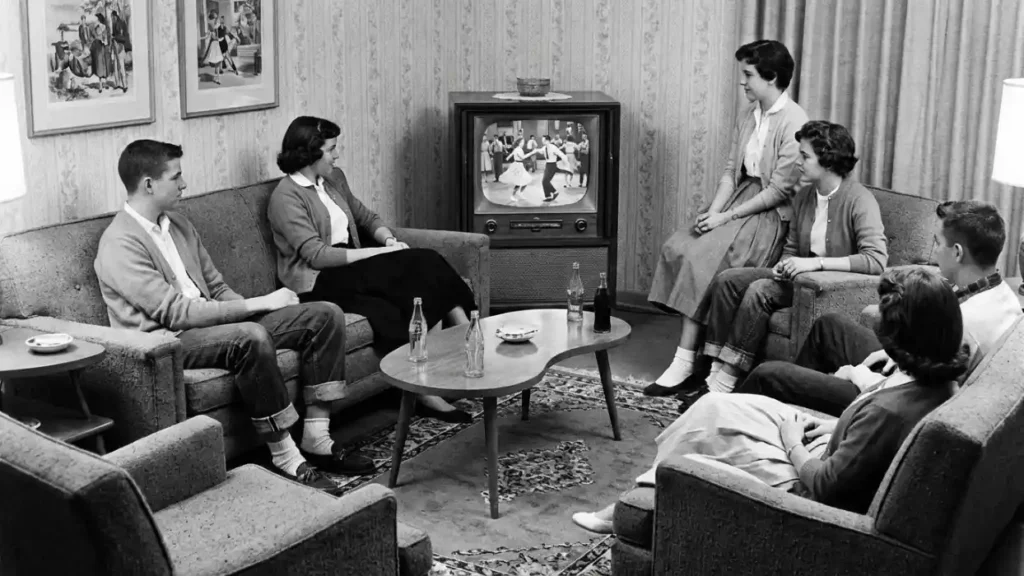
A quiet American living room, where a generation first saw itself reflected on screen.
In the summer of 1957, something unusual began to happen on American television.
What had once been a local Philadelphia dance program—known simply as Bandstand—was suddenly broadcast across the nation. It now carried a new name: American Bandstand.
And with that shift, something far bigger than a title change took place.
Every afternoon, millions of viewers tuned in not to watch actors or performers, but to watch teenagers. Real teenagers. Dancing, laughing, choosing records, and moving with a kind of ease that felt unscripted—because it largely was.
At first glance, the format was simple. A host, a turntable, a dance floor. But the real transformation was happening in front of the camera.
Before this moment, teenagers had rarely existed as a visible group in American media. They were present in families, in schools, in neighborhoods—but not as a defined cultural force. They were not yet an audience that television needed to understand, let alone represent.
American Bandstand changed that quietly, but permanently.
It did not just put young people on screen—it shaped how they were seen. The clothes, the movements, the behavior, even the unspoken rules of who belonged and who did not—all of it was framed, repeated, and sent into homes across the country.
For the first time, teenagers were not just growing up in America.
They were being watched by it.
The System Behind the Dance Floor
What made American Bandstand powerful was not just what appeared on screen—but how carefully it was constructed behind it.
At the center stood Dick Clark, whose calm, approachable presence helped the show feel effortless. But nothing about the program was accidental. The music, the pacing, the camera angles, even the teenagers selected to stand closest to the lens—all of it followed an emerging logic that television was only beginning to understand.
This was not just a dance show. It was a system.
Each afternoon, records played on American Bandstand did more than entertain—they influenced what America listened to next. A song featured on the show could see its popularity surge almost overnight. Record labels noticed. So did advertisers. What looked like a spontaneous gathering of teenagers was, in reality, becoming one of the most effective promotional engines in the country.
But the system extended beyond music.
The teenagers on screen became informal templates. Viewers at home studied them—how they dressed, how they moved, how they interacted. Subtle patterns began to form. Certain styles appeared more often. Certain behaviors were rewarded with more screen time. Without ever stating it outright, the show began to define what a “normal” American teenager should look like.
And just as importantly, what they should not.
The result was a feedback loop. Television presented an image. Teenagers across the country absorbed it. Then they returned to the screen, reflecting it back in slightly altered forms. Over time, the difference between real life and television began to blur.
American Bandstand did not invent youth culture.
But it was one of the first systems to organize it, package it, and send it back to the nation—day after day, frame by frame.
When Teenagers Became Visible
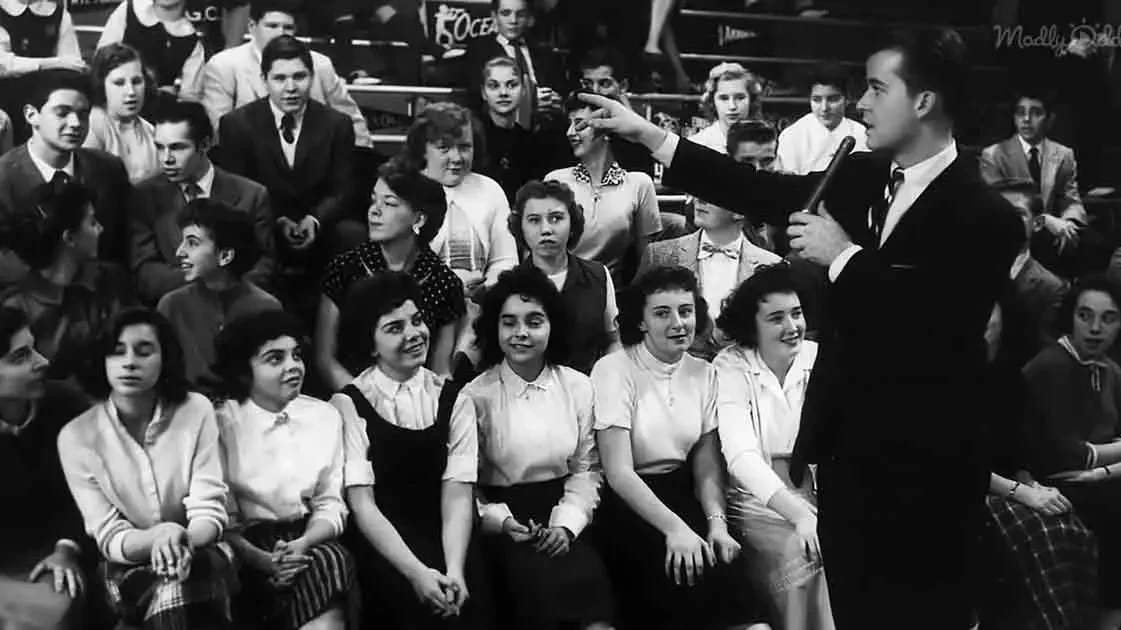
A shared image of youth began to take shape—one dance, one style, one screen at a time.
What American Bandstand ultimately changed was not just television—but visibility itself.
Before its national rise, teenagers existed in fragments. They were students, children, part-time workers, sons and daughters. But they were not yet a clearly defined cultural group with a shared image. There was no single reference point that told America what a teenager looked like, sounded like, or moved like.
American Bandstand became that reference point.
For the first time, teenagers across the country could look at a screen and see people who looked like them—not older, not idealized, not fictional. They saw hairstyles repeated from city to city. They saw clothing styles spread without explanation. They saw dances that did not belong to one region, but to a generation.
And slowly, something began to standardize.
A teenager in California could mirror a teenager in Philadelphia without ever meeting them. A girl in the Midwest could recognize a gesture, a posture, a way of standing—because she had seen it on screen the day before. What had once been local and scattered was becoming national and shared.
But visibility came with structure.
Not every teenager was shown equally. The camera favored certain faces, certain styles, certain behaviors that aligned with a broader image of acceptability. The dance floor looked open, but it was carefully filtered. What appeared natural was, in many ways, curated.
Still, the effect was undeniable.
For the first time, youth was no longer something that passed quietly from childhood into adulthood. It became a stage of life that could be observed, imitated, and remembered. Teenagers were no longer just living through a moment—they were performing it, often without realizing it.
And once that image took hold, it did something powerful.
It gave a generation a way to see itself.
What the Camera Didn’t Show
For all its openness, American Bandstand was never as neutral as it appeared.
The dance floor felt democratic. Anyone watching from home could believe that any teenager might step into that space and be seen. But in reality, the image of youth presented on screen was carefully managed—subtly shaped by expectations that were rarely spoken aloud.
There were boundaries.
Who stood closest to the camera mattered. Who was invited back mattered. Which couples were highlighted—and which were not—followed patterns that viewers were not meant to question. The result was a version of teenage life that looked effortless, but was quietly selective.
Race was one of the clearest fault lines.
Although the music often drew from Black artists and traditions, the visual space of the show remained overwhelmingly white, especially in its early years in Philadelphia. Integration did not arrive as a defining principle—it came slowly, unevenly, and often under pressure. What millions of viewers saw each afternoon was not the full reality of American youth, but a version of it that felt safe for national television.
There were other forms of control as well.
Movements that felt too suggestive could be discouraged. Clothing that seemed too bold might never make it to the front of the frame. Even spontaneity had limits. The freedom that defined youth culture was allowed—but only within a structure that television could contain.
And yet, this tension is precisely what made the show so influential.
Because while American Bandstand shaped how teenagers were seen, it also revealed how they were being shaped. It exposed the invisible rules—about behavior, appearance, belonging—that defined what it meant to be accepted in public life.
The dance floor was not just a place of expression.
It was also a place of negotiation.
Between freedom and control.
Between individuality and conformity.
Between what youth culture was—and what it was allowed to be.
From a Dance Floor to a Cultural Blueprint
What began on the studio floor of American Bandstand did not stay there.
By the early 1960s, the idea it introduced had already taken root: youth could be seen, shaped, and broadcast—and in doing so, it could influence everything around it. Music charts began to respond more directly to teenage taste. Fashion moved faster, guided not by designers alone, but by what appeared on screen. Even the concept of popularity itself started to shift, measured less by local reputation and more by national visibility.
The model was simple, but powerful.
Take a group. Put them on camera. Let the country watch. Repeat.
And the impact multiplied.
What American Bandstand established was not just a show format—it was a blueprint. One that would later evolve through new platforms and technologies, but would always follow the same core principle: visibility creates identity, and identity creates influence.
By the time MTV arrived decades later, the transition felt natural. The focus shifted from dancers to performers, from studio audiences to music videos—but the underlying idea remained the same. Young people were still watching themselves, learning how to move, how to dress, how to exist in front of a camera.
And then, the process accelerated.
With the rise of digital platforms, that feedback loop—first shaped in a Philadelphia studio—became constant and immediate. There was no longer a single dance floor. There were millions of them. Screens were no longer limited to living rooms; they lived in pockets, in hands, in every moment of daily life.
But the structure had not changed.
The need to be seen.
The pressure to fit an image.
The quiet awareness of being watched.
These were not inventions of the modern era.
They had already begun decades earlier—under studio lights, on a polished floor, with a record spinning in the background.
American Bandstand did not just capture youth culture.
It helped design the way it would be experienced for generations to come.
The Screen Goes Quiet, But the Image Remains
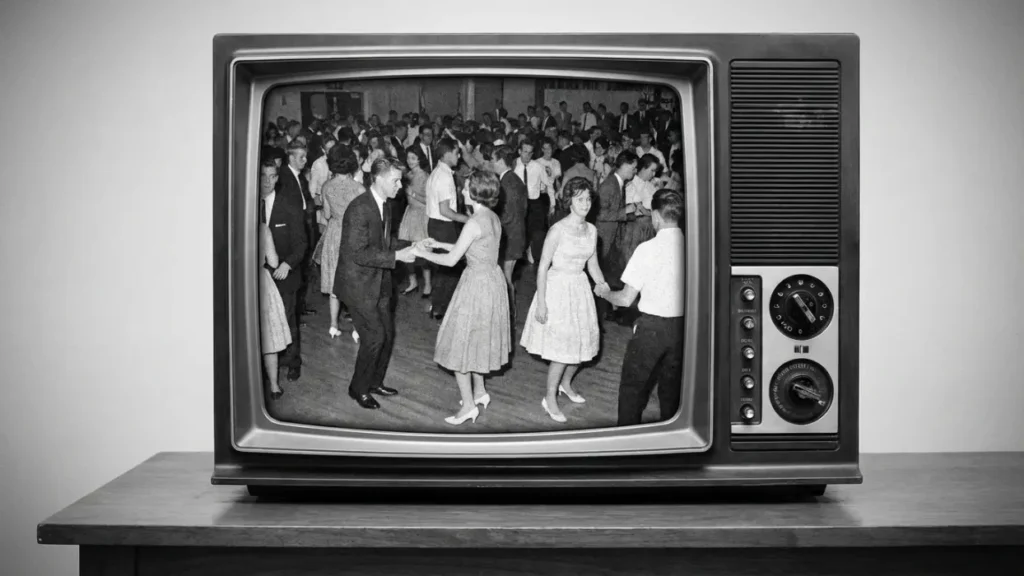
Long after the music faded, the image of youth remained—shaped by a screen that never truly went dark.
In the end, it is easy to return to that same quiet living room.
A television flickers in the corner. The sound is low. A group of teenagers moves across the screen—laughing, dancing, unaware of the weight of what they are part of. To them, it is just another afternoon. Another song. Another moment that will pass as quickly as it arrived.
But it did not pass.
Because what appeared on that screen did something no generation had experienced before. It gave shape to youth in a way that could be seen, repeated, and remembered. It turned something temporary into something observable. And once observed, it became something that could be defined.
American Bandstand did not set out to create this transformation. It did not announce the birth of a new cultural identity. It simply placed teenagers in front of a camera and allowed the nation to watch.
That was enough.
The image took hold. It traveled across cities, across states, across years. It changed how young people saw themselves—and how they believed they were meant to be seen. And even as the music changed, the technology evolved, and the screens became smaller and more personal, that original shift never fully disappeared.
Today, the stage is everywhere.
But the feeling is the same.
The awareness of being visible.
The instinct to perform, even in ordinary moments.
The quiet understanding that identity can exist not only in life—but on a screen.
All of it can be traced back, in some small but undeniable way, to that dance floor.
To those afternoons.
To the moment a generation first appeared—and realized it was being watched.

What American Bandstand Showed the Suburbs About Themselves
Who Remembers The Stroll? How One Dance Defined a Generation on American Bandstand

Bob Clayton: American Bandstand’s Dream Boy and the Life That Followed
About The Author

Arthur Pendleton
A lifelong fan of the golden era of music, dedicated to preserving the timeless memories and stories of American Bandstand.