What American Bandstand Showed the Suburbs About Themselves
How a half-sized studio in Philadelphia became a national mirror — and why a generation still recognizes itself in the reflection.
Saturday Afternoon, Everywhere at Once
It began with an absence.
Every weekday around three o’clock, the streets of suburban America went quiet. Not the quiet of bad weather or approaching dark — something more deliberate. Bicycles leaned against porch rails untouched. The loose noise of after-school simply ceased, on schedule, the same hour every day. What held a generation indoors was not obligation or weather or parental authority. It was a television program broadcasting from a half-sized studio on Market Street in Philadelphia — a room that held only 250 people, yet somehow made twenty million viewers feel they were standing inside it.
American Bandstand had discovered something the networks had not anticipated: that the most powerful thing a camera could do was point itself at the audience it was trying to reach. The suburbs had never seen themselves on television before. Not really. Bandstand showed them their own children — dressed as their own children dressed, moving the way their own children moved — and broadcast that image back across the country every single afternoon. It was, without anyone quite intending it, the first mirror that fit.
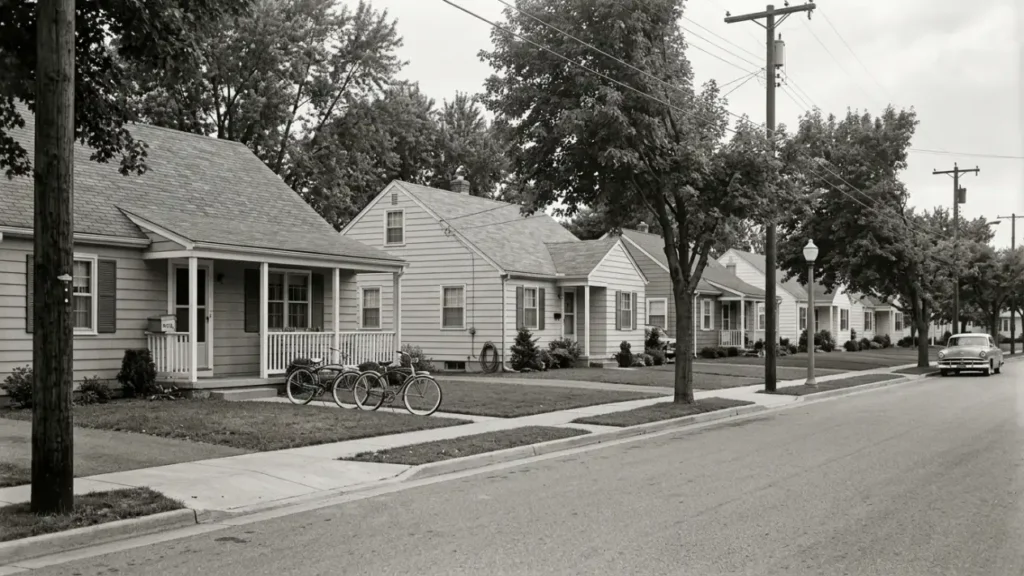
street in the late 1950s — quiet, mid-afternoon
The Machine That Made Ordinary Famous
The studio at 4548 Market Street was not impressive. Dancers described it as half the size it appeared on screen — a mishmash of colors, too loud, with tape on the floor marking the boundary they were not allowed to cross. Director Ed Yates sometimes moved the dissolve lever so that two cameras lit up at once, neither actually live, just to watch the dancers drift toward the false light. The illusion was the product. Everything visible on screen had been arranged to appear unarranged.
When American Bandstand went national on ABC on August 5, 1957, forty-eight affiliate stations carried it on the first day. By the second week, sixty. Within a month, twenty million viewers. The speed of that adoption was not accidental — ABC, the youngest and least established of the three networks, needed programming for afternoon hours, and producer Tony Mammarella had understood something essential: the teenagers in the studio were not participants in the show. They were the content itself.
Dick Clark, twenty-six years old when he took over as host in 1956, understood this with unusual clarity. He was not a rock and roll insider — a colleague noted that he “didn’t know Chuck Berry from a huckleberry” when he started. But he grasped the optics with precision. One cultural observer of the era described him as “the great tranquilizer,” reassuring parents that rock and roll was not bad. Clark himself was more direct about his method: “It was 150 percent deliberate and well thought out. In order to perpetuate my career, first and foremost, and secondly the music.”
The production decisions were equally deliberate. Boys came in jacket, shirt, and necktie. Girls were turned away for tight sweaters or low necklines. No gum. No smoking. Ages fourteen to eighteen only. The dress code was enforced at the door, never mentioned on air. What viewers at home saw was spontaneous youthful energy — what they were actually seeing was a managed performance of spontaneous youthful energy, curated to fit within what middle-class suburban parents of the late Eisenhower era would accept in their living rooms. The genius was that none of the management was visible. The construction read as authenticity.
The camera completed the effect by learning which faces drew mail. Week after week, certain dancers accumulated a kind of recognition that preceded fame without quite becoming it — visible enough to matter, anonymous enough to remain relatable. That was the balance the show required, and the director held it carefully.
What the Mirror Told Them
The suburbs that watched American Bandstand were, in many ways, a recent invention. The postwar housing boom had created entire communities of people who had moved from cities and farms into new geometries of cul-de-sacs and tract homes, carrying with them an anxious need to know what normal looked like. Bandstand supplied the answer, five afternoons a week.
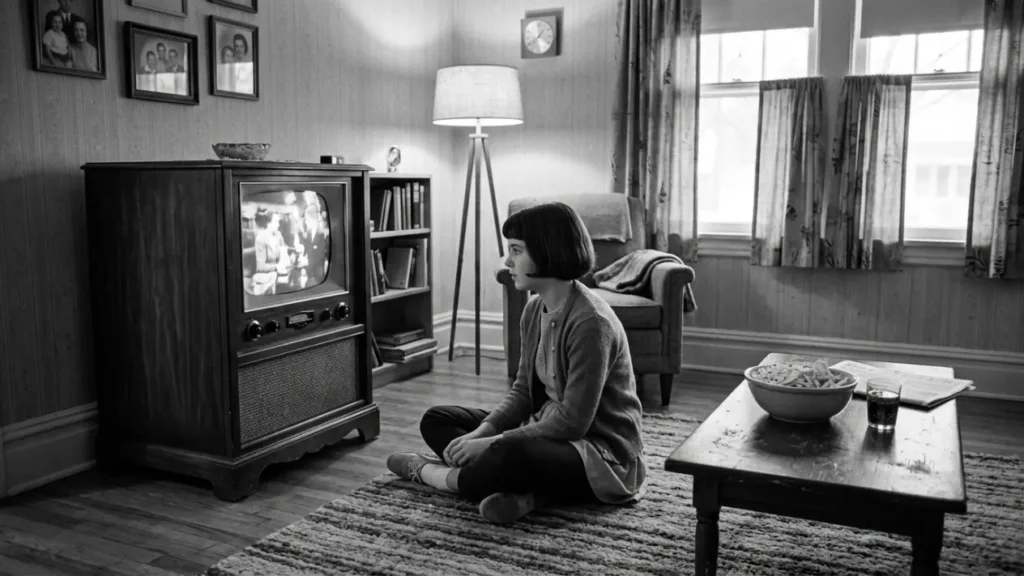
1950s American living room
What it supplied was not neutral. The show’s studio audience was overwhelmingly white, drawn from the Catholic high schools of West Philadelphia — girls from West Catholic got out early and were always first in line. The image of American youth that Bandstand broadcast nationally was a particular image: orderly, light-skinned, partnered in boy-girl couples, moving within sanctioned boundaries. For families in suburban Ohio or suburban Texas who had never lived near the urban diversity that Philadelphia actually contained, this was simply what American teenagers looked like. The mirror did not lie, exactly. It selected.
Gender expectations were embedded in that selection. The girls on Bandstand were watched; the boys were watched moving. The camera followed female dancers as objects of attention — neat, contained, expressive within strict limits — while boys were granted slightly more latitude to improvise, to initiate. These were not new arrangements, but television gave them a new solidity. Repeated daily at national scale, the image of how a girl should move and how a boy should move became, for a generation coming of age in those years, something close to instruction.
Consumer culture followed immediately. Sponsors discovered that teenagers were not merely watching Bandstand — they were indexing it, translating what appeared on screen into purchases. The right shoes. The right skirt length. The right cardigan. Bob Clayton accumulated 150,000 fan club members. Justine Carrelli, who first entered the studio at twelve using her older sister’s birth certificate, received a tiara with small diamonds within a week of mentioning on air that she liked them. The economy of teenage desire, which had barely existed as a category before the mid-1950s, found its first national classroom in a studio on Market Street. The suburbs were not just watching Bandstand. They were learning what to want.
The suburbs were not just watching Bandstand. They were learning what to want.
The Contradictions Underneath
The controlled surface of Bandstand concealed a series of contradictions that the era was not prepared to examine openly. The most significant was race. The show broadcast music made almost entirely by Black artists — rhythm and blues, early rock and roll, the dances that circulated through Black Philadelphia neighborhoods before they reached the white suburbs — while maintaining a studio audience that was, throughout the entire Philadelphia run, essentially segregated. Tony Mammarella, who produced the show from its first day, later acknowledged in an unpublished memoir that those involved had recognized the moral failure of the whites-only policy from the beginning, and had quietly trained themselves to justify it anyway.
The music itself told a different story from the images. When Chubby Checker performed The Twist in 1960, the song was a cover of a Hank Ballard original that had been circulating in Black communities for months. The dance had come from Black Philadelphia tradition. What arrived in the suburbs as something new and exciting had, in fact, traveled a considerable distance and changed hands before the camera found it. “We weren’t allowed to say that the Black people taught us,” one dancer recalled years later. Another was more direct: “That’s where we got all those dance steps. We stole them from the Black kids.”
The contradictions extended to the dancers themselves, who occupied an unusual and precarious position. They were famous in a way that had no precedent and no infrastructure — recognizable to millions, compensated with nothing, entirely dependent on the goodwill of a host who could remove them without explanation. Clark did remove them, and regularly. Justine Carrelli was gone the day she mentioned wanting to cut a record. Pat Molittieri was removed when Clark saw her face on the cover of Teen magazine. Kenny Rossi was let go on an accusation he denied for the rest of his life. Arlene Sullivan, informed at seventeen that she was banned, described it as “a McCarthy-like experience” — called into a room, given no reasons, simply told it was over.
The show that presented itself as a space of youthful freedom was also a space of surveillance. Clark watched from the floor. The cameras watched from above. The tape on the studio floor marked the boundary. The dress code managed the image at the door. The freedom on screen was real enough to feel genuine and managed enough to serve the sponsor. Those two things were not in conflict. They were the same thing.
The Architecture That Remained
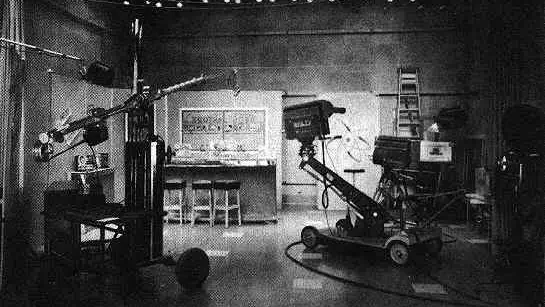
television studio in the early 1960s
American Bandstand ended its Philadelphia run on February 1, 1964, with a last song by Johnny Tillotson and a studio audience that had been shrinking for two years. Eight days later, the Beatles appeared on The Ed Sullivan Show. The British Invasion was beginning, and the particular cultural moment Bandstand had inhabited — the orderly, supervised, carefully mirrored suburb — was already shifting beneath its feet.
But the architecture of what Bandstand built did not disappear with the show. It migrated. The logic of selecting ordinary-looking young people, placing them in front of cameras, and broadcasting their image as aspirational — that logic appeared again in MTV’s earliest years, in the careful construction of what a music video viewer was supposed to look like and want. It appeared in reality television’s selection processes. It appears now in the mechanics of influencer culture, where the appearance of authentic self-expression is produced with considerable deliberate effort, and where the camera still rewards consistency of image above almost everything else.
The structural parallels are not causal — Bandstand did not cause these things to happen. But it demonstrated, earlier than almost any other media form, that an audience could be made to see itself in a broadcast and find that reflection desirable. Once that was established, the template was available. The half-sized studio on Market Street had solved a problem that the culture would keep solving, in different forms, for decades to come.
What the Tape on the Floor Remembered
At the end of each broadcast, the curtains behind Dick Clark were pulled open to reveal a cement wall and a large garage door. The door rolled up. Sunlight came in. The show was over.
The studio was half the size it appeared. The spontaneity was managed. The mirror was selective. And yet the twenty million people who watched from their suburban living rooms were not wrong to feel that they had seen something real. They had seen a version of themselves — cleaned up, dressed to code, moving within sanctioned limits — reflected back with the authority of national broadcast. For a generation still learning what it meant to live in those new houses on those new streets, the reflection was not false. It was aspirational. Which is a different thing, and in some ways more durable.
The dancers aged out and moved on — shoe stores, real estate, hospital reception desks, a blackjack table in Atlantic City. The studio is gone. What remains are the afternoons themselves, preserved on tape in the particular stillness of things that no longer exist. Anyone who watched those broadcasts as a child and watches them now will recognize something that is not nostalgia exactly — more like the mild vertigo of seeing yourself in a photograph you had forgotten was taken.
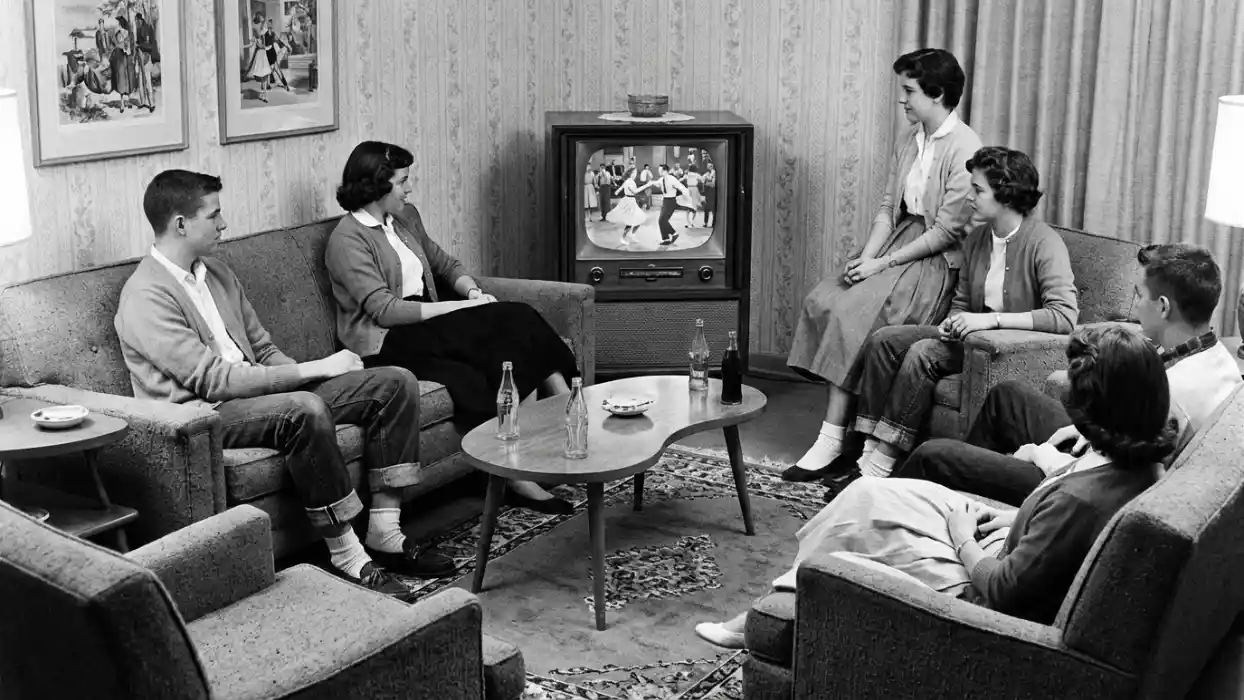
The Birth of the Televised Teenager: How American Bandstand Changed Youth Forever
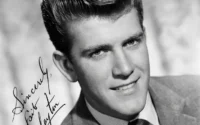
Bob Clayton: American Bandstand’s Dream Boy and the Life That Followed
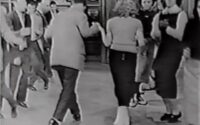
Who Remembers The Stroll? How One Dance Defined a Generation on American Bandstand
About The Author

Arthur Pendleton
A lifelong fan of the golden era of music, dedicated to preserving the timeless memories and stories of American Bandstand.