Bob Clayton and Justine Carrelli: American Bandstand’s Sweethearts — Did They Ever Marry?
For years, fans of American Bandstand asked the same question about Bob Clayton and Justine Carrelli. Nobody on screen ever answered it.
What America Saw
There was nothing accidental about the way Bob Clayton and Justine Carrelli became famous. But there was nothing calculated about it either. They were two teenagers from the Philadelphia area who happened to find each other on the floor of a television studio — and six million people happened to be watching when they did.
American Bandstand had gone national on August 5, 1957, reaching sixty-seven television stations across the country and settling almost immediately into the rhythm of American afternoons. Teenagers rushed home from school to watch other teenagers dance to the latest records, rate new songs, and move through the particular rituals of a generation that was, for the first time, being seen by the whole country at once. The show broadcast live five days a week from WFIL’s Studio B in Philadelphia, and by the end of its first national year it was reaching four million homes.
What those homes saw, when they tuned in, was something television had not quite offered before — the unscripted texture of young people being themselves. And among the faces that returned to the screen day after day, two in particular caught and held the country’s attention. A blonde girl from Southwest Philadelphia who moved through the room with the ease of someone entirely comfortable being watched. And a boy from Wilmington, Delaware, who had driven thirty-two miles up Route 13 to find her.
How It Began
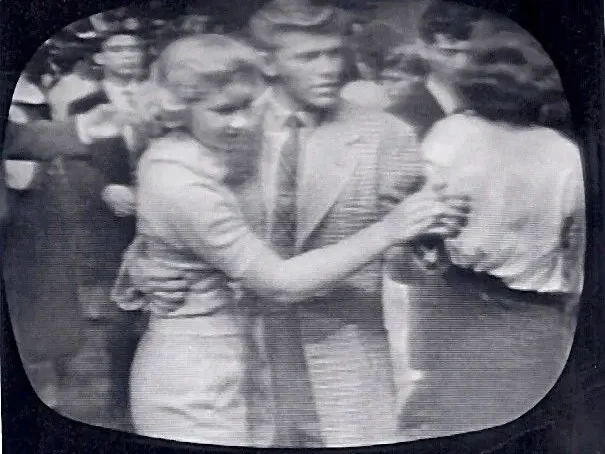
Justine Carrelli had been dancing on Bandstand since 1956, when she was twelve years old — two years younger than the rules allowed. She had borrowed her older sister’s birth certificate to get past the doorman, and within weeks she was a familiar face to viewers across Philadelphia. By the time the show went national, she was already one of its most recognized regulars.
Bob Clayton was watching from Wilmington. He had been dancing on a local program called Grady and Hurst’s show, so he understood something about a studio floor. But what he saw on Bandstand was different. There was Justine — dancing, he later recalled, without a steady partner — and something in that image would not leave him alone.
He skipped study hall, borrowed his father’s black Chevrolet Impala, and drove thirty-two miles up Route 13 to Philadelphia without telling anyone where he was going. He walked into Studio B and found Justine Carrelli. She told him she had a boyfriend. He thanked her for the information and asked her friends to dance instead. He worked his way through the room with the patience of someone who had already decided how the afternoon was going to end. Near the close of the broadcast, he walked back to her.
“Are you going to dance with me or what?” he said.
She said okay. They danced. And Justine, in interviews years later, described the sensation with the kind of simplicity that is harder to achieve than it sounds. It was, she said, like she had danced with him forever.
A week later, Bob told her she was going to be his girlfriend. She did not entirely disagree.
What the Country Decided
The letters began arriving almost immediately. Viewers had seen something in the way Bob and Justine moved together — a chemistry that the camera caught without either of them performing it. Fan mail poured into the studio. Their names circulated through the conversations of teenagers from Phoenix to Brooklyn, from Miami to Los Angeles, in the particular way that only television could transmit in 1957.
Dick Clark, writing about the show years later, described them as “the dream couple of the show, the star-struck lovers,” and added that they “personified the innocent lyrics of the songs they danced to.” It was an accurate observation. They seemed, to the millions watching, to be genuinely invested in each other — not displaying romance for the camera but living it in front of one, which is a different thing entirely.
The fan clubs followed. By the height of their Bandstand years, Bob Clayton alone had approximately half a million fan club members across the country. For less than a dollar, a fan could receive a membership card, a newsletter, an autographed photograph, and periodic updates on where Bob would be appearing and what he had been doing. Justine received hundreds of dolls after mentioning on air that she collected them. Bob received cufflinks from all over the United States after saying he liked shirts with French cuffs. They appeared on magazine covers, in newspaper features, at dances and shows across the country.
In 1957, they entered the Jitterbug contest together. One million postcard votes came in. Bob and Justine won. Each received a jukebox loaded with two hundred records — the kind of prize that the era understood instinctively, music made tangible, something you could carry into a room and play on a winter afternoon.
And through all of it, the question that no fan letter quite dared ask directly hovered over everything: were they going to get married?
The Question Everyone Was Asking
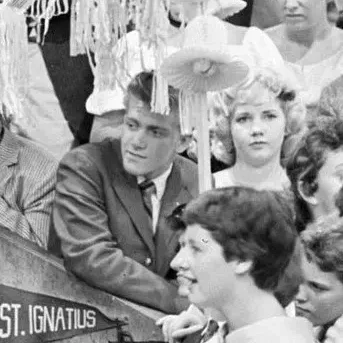
It was a different era. The word “going steady” could not be spoken on American Bandstand — network censors worried it implied that a boy and girl were more than friends. The phrase “getting pinned” was equally forbidden. What the show could offer, and what it delivered every afternoon, was something more powerful than words: the image of two people who kept choosing to dance with each other, day after day, in front of the whole country.
For the teenagers watching at home, Bob and Justine were not simply a popular couple on a dance program. They were a proof of something — that the feelings stirring in living rooms and school hallways across America were real, were shared, were visible. When Justine described Bob in interviews, she spoke with the particularity of someone telling the truth. When Bob described their dancing — the Jitterbug, and the slow dances, holding her close — he did so without embellishment, which made it more affecting than embellishment would have been.
In August of 1958, when Dick Clark took a vacation, Bob Clayton was one of only six disc jockeys ever asked to fill in as host of American Bandstand. He stood behind Clark’s elevated podium, introduced the records, and conducted Roll Call with the ease of someone who had been paying attention. Whether he imagined, in that moment, that this was a door that might open further, is something no record tells us clearly. But the ambition was always present, quiet and persistent beneath the easy confidence.
The country watched. The country wondered. And the answer, when it came, came from an unexpected direction.
The Record That Changed Everything
Bob and Justine recorded a song together called “Drive-In Movie” on the Fransil label. It was, from a certain angle, a logical decision. They had half a million fans. They had name recognition that most recording artists spent careers building. What they had not fully accounted for was a rule, unwritten but absolute among Bandstand’s producers: regulars did not release records while appearing on the show. The moment a dancer became a recording artist, the quality that made them valuable — their ordinariness, their sense of being just like the kids at home — was gone.
The record was released. Both of them were removed from the show. The record did not sell.
The romance did not survive the transition. Justine was direct about it in interviews years later. Bob, she said, had developed a wandering eye. She had been heartbroken. She told him, in terms she recalled with some amusement decades on, to hit the road. Bob, for his part, acknowledged the characterization without much argument. They had been outgrowing each other, he said. He supposed he had a roaming eye.
Whatever the precise truth, the partnership that had seemed — to six million daily viewers — like the natural extension of every love song they had ever danced to, ended without ceremony. Not with a wedding. With a record that nobody bought, and a conversation that nobody witnessed.
The question the fans had been asking had its answer now, though no one announced it on air.
Two Lives, Separately Lived
Bob went to Hollywood in 1960 to pursue a screen test. He was five feet eight inches tall and found himself surrounded by men who were six feet. He assessed the situation clearly, called his father, and asked for money for the trip home. There was no bitterness in the telling of this story. It reads, in the historical record, more like the account of someone who had taken an honest measurement and acted accordingly.
He returned to Delaware and built a life in retail — Storm’s Shoes, then The Little Heel, then Wanamaker’s Department Store, then four stores of his own, then a career in the chemical business at Diamond Chemical and Supply Company, where he worked until he retired in 1998. He had a drinking problem in those years, quit cold turkey in 1980, and recovered. He married Elizabeth — known to everyone as Litzie — in 1985. They had three children: Sheri, Kristine, and Robert Wayne, known as Toby. They had a boat. They had thirty-one years together, until his death on November 6, 2016, at the age of seventy-five.
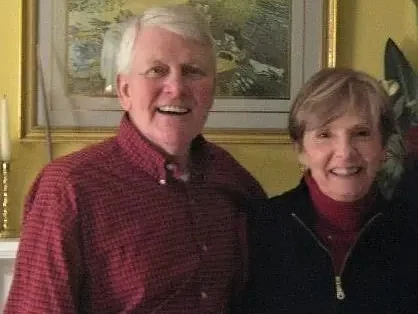
Justine’s path moved differently. She had left Bob behind before any of that — not gradually, but in the particular way that life sometimes arranges its turning points. A local singer named Paul Dino Bertuccini appeared on Bandstand one snowy afternoon, performed his song, and won Justine’s attention in a way that settled the question of Bob more finally than any argument could have. She became a singer herself, performing with Paul Dino’s review on both coasts. She married him. They had two sons — Paul and John. The marriage lasted fifteen years before ending in divorce. Justine was also, in those years, a gifted sketch artist and could style hair with the ease of someone who had trained for it, though she had not. These were the quieter talents that the camera at Studio B had never thought to capture. She eventually earned her real estate license and built a second career in a small town called Dolan Springs, Arizona, population just under two thousand. In 2012, she was found there by a man named Jim Miller, who had watched her on Bandstand as a junior high school student on Long Island and had never quite stopped wondering what had become of her. They married in 2014. She passed away on May 24, 2023, at the age of seventy-nine — in a Philadelphia hospital just a few blocks from where the American Bandstand studios had once stood, having returned to the city to visit family one last time.

Two people. Two complete lives. Lived in full, in separate directions, after the cameras stopped.
The Dance They Never Forgot
In 1992, at the fortieth anniversary reunion of American Bandstand, Bob Clayton and Justine Carrelli saw each other for the first time in years. They danced.
“It was like we had never stopped,” Bob said afterward. “We used to dance every day for four hours.”
Justine, for her part, had said something years earlier that stayed with anyone who heard it. “There were other famous couples,” she said, “but we seem to be the ones most remembered. Your real first love is something you never forget.”
They remained friends — Bob and Litzie, Justine and Jim, four people in late middle age who found it natural to share a dinner table and easy to be in each other’s company. There are photographs of them together, the kind of photographs that do not require explanation. Two couples who had arrived at their lives by entirely different routes, and found, at the end of them, something uncomplicated and good.
The fans who had wondered for decades about Bob and Justine would have recognized, in those photographs, something they had not expected. Not the ending they had hoped for when they were teenagers watching an afternoon dance program. But something more honest, and in its own way more satisfying — two people who had loved each other first, lived their lives fully, and remained, genuinely glad the other one existed.
What the Question Was Really About
For years, fans of American Bandstand asked whether Bob Clayton and Justine Carrelli ever married. The answer is no. But that was never really the question.
What the fans were asking — what they had always been asking, without quite knowing it — was whether what they saw on that screen was real. Whether the feelings that a dance program had stirred in living rooms across America meant something. Whether two ordinary teenagers from Wilmington and Southwest Philadelphia had actually felt, for each other, what it looked like they felt.
They had. And they didn’t marry. And they stayed friends until the end of their lives. And the dance floor at Studio B in Philadelphia, which was torn down long ago, somehow still holds all of it — the jukebox, the cherry Cokes, the thirty-two miles up Route 13, and the particular way two people moved together when they thought nobody was watching.
When Justine passed away in May 2023, it was in a Philadelphia hospital just a few blocks from where the American Bandstand studios had once stood. She had come back to visit family, and the city had kept her one last time. It was the kind of detail that life arranges without asking permission.
Six million people were watching. And the question they asked was never really about the answer.
It was about what the question said about all of us.
Sources: History of Rock (history-of-rock.com); Robert H. Clayton obituary, The News Journal / Legacy.com, December 2016; Justine Ann Carrelli-Miller obituary, May 2023; Parade Magazine, May 2012; WGCU/WUSF public radio feature, January 2023; Dick Clark, memoir; American Bandstand fan archive, marshasvintage.com; Women of Wisdom Magazine.
The Boy in the Reversed Sweater: Kenny Rossi’s Life After American Bandstand
American Bandstand’s Pat Molittieri: The Girl Who Invented a Dance and Paid Everything for It
What Arlene Sullivan Was Really Hiding Behind Those Perfect Dance Steps
About The Author

Arthur Pendleton
A lifelong fan of the golden era of music, dedicated to preserving the timeless memories and stories of American Bandstand.