Who Remembers The Stroll? How One Dance Defined a Generation on American Bandstand
Before American Bandstand, a dance had to be taught. After it, a dance only had to be broadcast. What happened in between changed how a generation understood itself.
A Saturday afternoon in Philadelphia
The Stroll was a peculiar dance. Nobody touched. Two lines stood apart from each other — boys on one side, girls on the other — and each couple in turn walked through the middle as though performing before the whole world. Because, in truth, that is exactly what they were doing. Before ten million pairs of eyes.
Nobody on that dance floor was famous. That was, in 1957, the most radical thing about it. Television had always needed a reason to point a camera at someone — a talent, a title, an achievement. American Bandstand pointed its cameras at teenagers simply because they were there, and young, and moving to music.
You only needed to turn on the television.
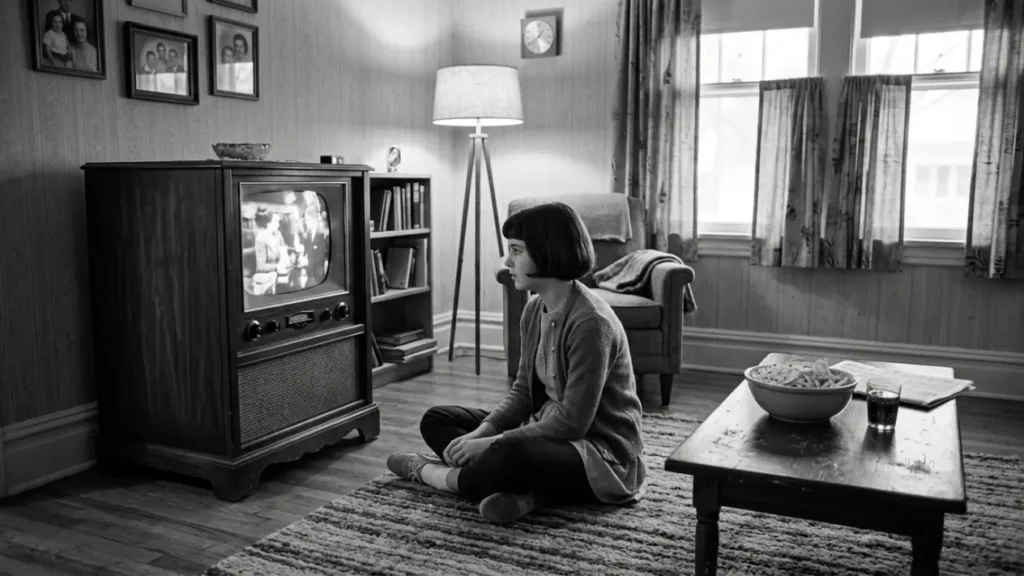
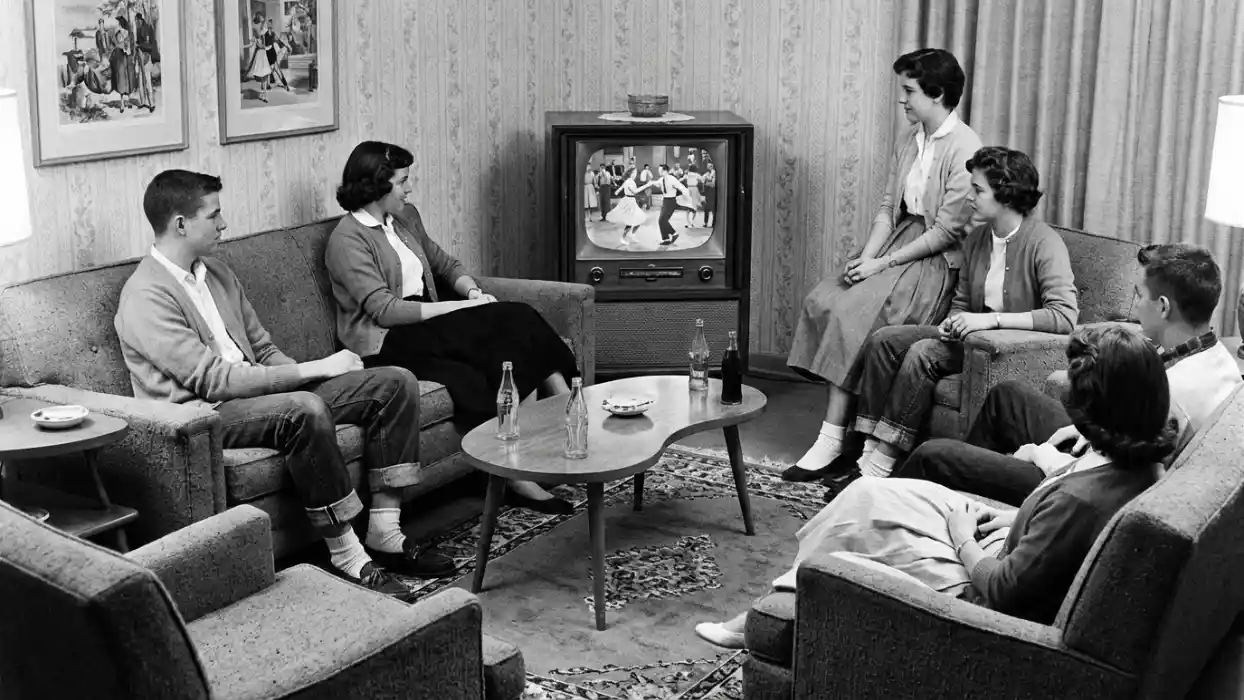
That sounds simple enough. At the time, it was anything but. For the first time in American history, youth was no longer something that happened in schoolyards or on street corners. It was lit, framed, and broadcast. And millions of teenagers sitting before those screens recognized something their parents’ generation had never been offered: a mirror that reflected them back to themselves.
How the machine worked
Before American Bandstand reached a national audience in August 1957, American television was still searching for its own language. News programs, game shows, and variety hours were slowly shaping the viewing habits of the country — but none of them had answered a question quietly burning through the culture: where, on this new medium, did the young belong?
ABC Network saw the gap. When the network acquired the Philadelphia station’s local program Bandstand and expanded it to national broadcast, the decision was not simply about scheduling — it was about structure. Rather than placing adults at the center of performance while younger audiences watched passively, the redesigned program put teenagers on the floor itself. They danced. They rated the records. They appeared on screen not as someone’s children, but as independent figures in their own right.
The camera played a decisive role. Operators learned to track movement, to catch a close-up as a couple stepped through the two lines, to pan across the room and capture the full texture of collective energy. This was not a stage production — it was a new visual grammar, built for a new generation. The technique, crude by today’s measure, produced something television had never managed before: the sensation of being inside the room.
Dick Clark, who took over as host in 1956, understood this mechanism better than anyone. He was not a pop star — he was a constructor of atmosphere. With a measured voice, a tidy suit, and an instinct for creating intimacy even before a national camera, Clark transformed the Philadelphia studio into a room that any teenager in America could imagine walking into. He did not instruct. He invited.
The program sold parents one image: your children are dancing in order. And it sold teenagers something else entirely: the feeling of being seen.
Behind that invitation, however, was a tightly managed system. Dress codes were enforced: no jeans, no T-shirts, nothing that suggested defiance. Music was filtered. Guests were selected with care. The spontaneity on the dance floor was genuine — but the container holding it was entirely constructed.
What the machine produced
When The Stroll first appeared on Bandstand in late 1957, it was not announced as a phenomenon. It simply arrived — danced, filmed, broadcast. Within a matter of weeks, teenagers across the country knew it as their own.
It was the first time in American history that a dance spread not through clubs, not through instructors, not through neighborhood gossip, but through a screen. The mechanism — watch, imitate, belong — was entirely new to popular culture. A teenager in rural Kansas who had never been east of the Mississippi could step into the same dance, at the same moment, as a girl on a Philadelphia dance floor. Television had compressed geography into a shared present.
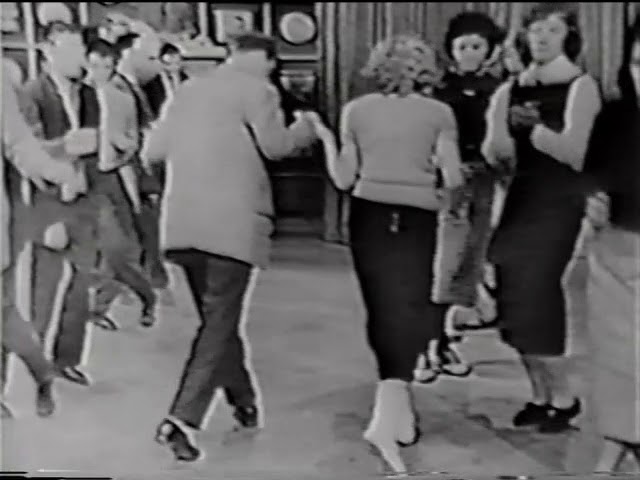
But The Stroll was not only a dance. Its form — two parallel lines, separated by sex, each couple performing in turn for the others — reflected the social expectations of the era with an almost architectural precision. Girls stood in line in full skirts, composed and waiting. Boys stepped forward first, set the pace. That division was never written into any rulebook; it was simply the air the generation breathed. Television did not create those gender norms. But it illuminated them, framed them, and delivered them into ten million living rooms as a model.
At the same time, Bandstand was doing something more complicated with racial identity. The program aired during a period when legal segregation still governed much of the South. The Philadelphia studio, in principle, admitted both white and Black teenagers — but in practice, invisible boundaries held. The music of Black artists was played, danced to, and loved. The artists themselves were not always welcomed as equal guests. The culture moved faster than the institution that was broadcasting it.
And behind all of it was an economic force gathering strength: the spending power of the American teenager. The 1950s saw the emergence of an entirely new market — young people with allowances, with desires, and with Bandstand as a near-perfect advertising channel. Every popular dance meant records sold. Every outfit noticed on the dance floor became a fashion moment. Television and the teenage market grew together, each feeding the other.
The tension beneath the surface
There was a paradox at the heart of American Bandstand that no one named aloud, but everyone felt. The program sold freedom — the freedom to dance, to express, to be seen before a national audience. But that freedom was held inside a very carefully constructed cage.
Every teenager who walked onto the Philadelphia studio floor understood — without being told — that certain things were not permitted. Nothing too suggestive. Nothing too intimate. Nothing that might unsettle a parent watching at home. This was not a Friday night party or a basement rec room. This was television. And television, in the 1950s, was still negotiating its place inside the American family.
Parents worried. Rock and roll, with its insistent rhythm and often ambiguous lyrics, had been treated by a portion of American society as a moral hazard. Bandstand answered that anxiety not with argument, but with image: look, your children are dancing in clean clothes, under clean lights, with clean smiles on their faces. There is nothing dangerous here. Everything is in hand.
But that very control produced an interesting friction. The teenagers on the floor knew they were being watched — and they played with it. A glance that held the camera a moment too long. A smile slightly wider than necessary. A step that pushed just slightly past the boundaries of the permitted. It was a quiet negotiation between the individual and the structure, between expression and surveillance — and it played out live, on national television, every afternoon.
On the question of race, the tension was sharper still. Rhythm and blues — the music of Black communities across the urban North and the rural South — was filling the Bandstand soundtrack, being danced to by white teenagers in Philadelphia, and being embraced by audiences across the country. That cultural exchange was real and consequential. But it did not arrive with equality attached. The music was welcomed long before the people who created it were.
The long shadow
What American Bandstand constructed was not simply a television program. It was an architecture — a way of organizing the relationship between young people, a camera, and a mass audience. That architecture, however much its surface has changed across the decades, has never fully gone away.
When MTV launched in 1981, it did not copy Bandstand — but it inherited the same foundational question: how do you turn music into image, and image into identity? The answer took a different form, but the underlying structure was strikingly familiar: a performance space, a camera, a generation that wanted to be seen.
Decades later, when short videos began spreading across handheld screens and a dance could travel from one side of the country to the other within hours, that structure was not entirely unrecognizable. Bandstand did not produce those platforms — the distances in technology and culture are too vast to suggest anything so direct. But both asked the same question of the young people standing before them: if someone watches you dance, do you want them to follow?
The meaningful difference is one of access. In 1957, only a small number of teenagers stood before that camera. Today, nearly anyone can. But the pressure behind the frame — to look right, to fit the moment, to earn the approval of an unseen audience — remains familiar. The frame itself, whether a Philadelphia studio or a phone screen, still poses the same question to every young person who steps in front of it: are you worth watching?
A quiet return
The Stroll is still there — in black-and-white footage, in documentary clips, in the memory of those who stood on the Philadelphia dance floor or sat before a television set in some small town and saw themselves, for the first time, reflected on a screen.
That generation grew up. They moved forward, carried their world with them, and left the studio lights far behind. But the images remained — frozen in the brightness of a Saturday afternoon in 1957, in the sound of a song that once swept the nation, in two lines of young people facing each other across a dance floor, waiting for their turn to walk through.

It is what television learned very early, and never forgot: images of youth do not age. Only the people in them do.
American Bandstand · Longform Journalism Series · Refined Edition — April 2025
What American Bandstand Showed the Suburbs About Themselves
Bob Clayton: American Bandstand’s Dream Boy and the Life That Followed
The Birth of the Televised Teenager: How American Bandstand Changed Youth Forever
About The Author

Arthur Pendleton
A lifelong fan of the golden era of music, dedicated to preserving the timeless memories and stories of American Bandstand.