The Boy in the Reversed Sweater: Kenny Rossi’s Life After American Bandstand
Three hundred fan clubs. Nine failed singles. One successful company. One marriage that lasted forty years. This is what became of the most popular boy on American Bandstand.
A Boy in the Studio Lights
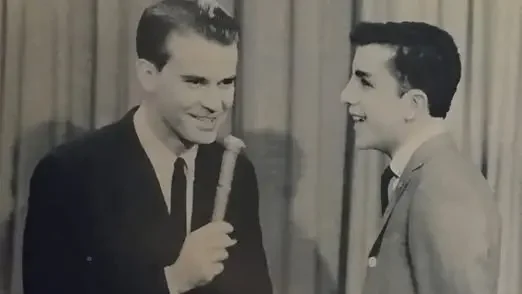
There is a particular kind of stillness that settles over old television footage — the slightly washed-out contrast, the motion that looks both urgent and dreamlike at once. Watch the kinescopes from American Bandstand’s Philadelphia years and you will find him there, somewhere near the center of the frame: a dark-haired teenager in a V-neck sweater worn deliberately backward over his collar and tie, white buck shoes catching the studio light as he moves. His name was Kenny Rossi, and in the late 1950s, twenty million Americans knew exactly who he was.
That boy is frozen there still — perpetually fifteen, perpetually dancing, perpetually the most popular kid in a room that happened to be broadcast to the nation. But time does what television cannot. It keeps moving. The boy in the studio grew into a man, built a life far removed from those afternoon broadcasts, raised a family, ran a business, and carried the memory of those years with a kind of calm, clear-eyed perspective that only distance and decades can produce.
Kenny Rossi passed away on March 8, 2024, at his home in Havertown, Pennsylvania. He was eighty years old. The cameras had long since turned away — but the life he built after them was, by any measure, the more remarkable story.
The Most Popular Boy in the Room
He almost didn’t go. It was his mother who pushed him — she wanted to see what her son looked like on television. Kenny Rossi climbed the steps at 4548 Market Street in West Philadelphia for the first time in 1957, walked past the line of teenagers waiting outside, and found a seat in the bleachers. He was fourteen years old. West Catholic High School, where he was a student, stood just a few blocks away.
Within months, he was the most recognized teenager in America.
American Bandstand had gone national on ABC in August 1957, and its audience grew with startling speed — twenty million viewers tuning in each weekday afternoon to watch Philadelphia teenagers dance to the songs climbing the charts. Among the regulars, certain faces pulled the camera. Kenny Rossi pulled it harder than most. Dark eyes, easy movement, and a personal style that was quietly distinctive — the V-neck sweater reversed over the collar, the white bucks — he became the kind of figure that fans felt they personally knew.
Arlene Sullivan, who would become his on-screen dance partner and one of his closest lifelong friends, remembered the moment she first spotted him. He was sitting in the bleachers looking, she said, a little lost — the way she had felt when she first arrived. She walked over and asked if he wanted to dance. He said yes. That was how one of American Bandstand’s most beloved pairings began: not with orchestration or producer matchmaking, but with a shy girl approaching a shy boy in a crowded studio.
The fan response was immediate and overwhelming. At his peak, Kenny Rossi had an estimated three hundred fan clubs operating across the country. He received more than a hundred sets of cufflinks for his fifteenth birthday, sent by strangers who felt, inexplicably, that they knew him. A father once drove his daughter from Fall River, Massachusetts, simply so she could stand near him. The mail arrived in volumes that required sorting.
None of this came without a cost. At West Catholic High School, the brothers had to physically escort Kenny from the building each day and watch him walk far enough down the street toward the studio before they returned inside. His classmates, who considered dancing a source of shame rather than celebrity, made the journey difficult. He was in a fight, he later said, nearly every morning. And the hostility did not end at the school gates — one evening, walking with Arlene through North Philadelphia after visiting a fellow regular, a group of men ambushed them on the street outside an apartment building. Arlene swung her pocketbook. Kenny ran. They barely made it over the turnstile at the elevated train station ahead of their pursuers.
He was fifteen years old. He had done nothing except show up and dance.
The Exit That Changed Everything
The departure from American Bandstand was not graceful. It rarely was for the regulars who left under a cloud — and Kenny Rossi’s exit, in 1958, carried enough ambiguity to stay with him for the rest of his life.
Dick Clark’s rules for the show’s regular dancers were unwritten but absolute. They were not professionals. They could not be paid for appearances, could not record commercially, could not leverage their Bandstand visibility for personal gain. The moment they crossed that line — real or alleged — they were gone. Pat Molittieri had been removed for writing a magazine column. Bob Clayton and Justine Carrelli for mentioning a record deal on air. The exits were swift and usually offered no hearing.
Kenny Rossi was accused of accepting payment for a record hop appearance in Passaic, New Jersey. He denied it. He denied it that day, denied it in the years that followed, and by all accounts continued to deny it for the rest of his life. Whether the accusation was accurate was almost beside the point. The decision had been made. He was told not to come back.
Arlene Sullivan, who watched from the studio floor, described the atmosphere surrounding such removals as “a McCarthy-like experience” — teenagers called in without warning, told they were gone, offered no appeal. She and Kenny remained close long after both had left the show, bound by the peculiar solidarity of people who had shared something strange and briefly enormous.
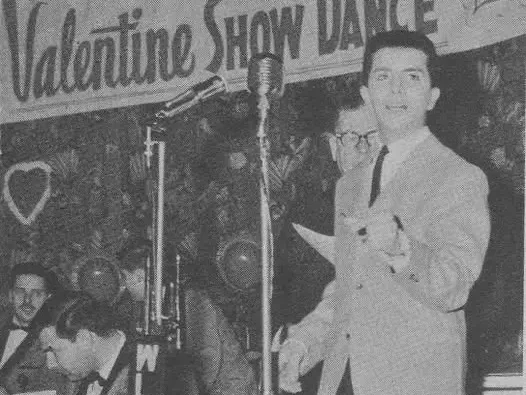
The music career that followed was, by the standards Kenny might have imagined for himself in 1958, a disappointment. He recorded with genuine ambition across multiple labels — Adelphia, Gee, Roulette, Gone, Mercury, and finally Arctic — releasing nine singles between 1959 and 1966. He toured on Dick Clark’s Caravan of Stars, performing for audiences who remembered him from the dance floor. He met Elvis Presley in Nashville. He had the looks, the name recognition, and the work ethic. What he did not have was a hit.
By 1966, when his final single appeared on the Arctic label — a pop-inflected cover of Bobby “Blue” Bland’s “Turn On Your Love Light” — the teen idol moment had definitively passed. The British Invasion had reshuffled everything. The Philadelphia sound that had made Frankie Avalon, Bobby Rydell, and Fabian into stars was itself fading. Kenny Rossi was twenty-three years old and starting over.
Building Something That Lasted
What Kenny Rossi did after the music stopped is the part of his story that tends to get summarized in a single sentence — and then passed over quickly, as though the years between youth and old age were merely connective tissue between the interesting parts. They were not.
After the singing career ended, he spent time working as a talent agent, navigating an industry he understood from the inside out. Later he moved into book publishing, a quieter world that suited a man who had learned, early, the difference between visibility and substance. These were not false starts so much as a man in his twenties and thirties finding his footing in a world that no longer had a clear place for him.
The skills he had — an instinct for people, a natural ease with strangers, a memory for what it felt like to walk into a room and hold attention — were real. They simply needed a different application.
He found it in the 1980s when he founded Arid Waterproofing, a construction services company based in the Philadelphia area. The business grew from the ground up, with no inherited capital and no industry connections. Within five years it had reached a valuation of five million dollars. Kenny Rossi, reflecting on that growth in later years, was characteristically direct about what had driven it. The ability to communicate, to listen, to build trust with people who had no particular reason to give it — he had learned all of that in a television studio at the corner of 46th and Market Streets, in front of cameras he had learned to read like a second language.
The parallel is not incidental. American Bandstand had been, at its core, an exercise in human connection conducted at industrial scale. The teenagers who thrived on it were not the most technically skilled dancers or the most conventionally attractive. They were the ones who came across as genuinely present — who made twenty million viewers feel that the screen between them was thinner than it appeared. That quality does not disappear when the lights go down. It transfers.
He married Lonni in 1981, and the marriage endured for the rest of his life — more than four decades, until his death in 2024. They settled in Havertown, a quiet township west of Philadelphia, and raised two children, Nicole Rose and Jonathan. A granddaughter, Viviana, arrived in later years. His brothers Bob and Alan remained part of his life. The rhythms of his adulthood — work, family, the ordinary accumulation of years — bore little resemblance to the compressed, hypervisible adolescence he had lived at fifteen. That was precisely the point.
He remained close to Arlene Sullivan throughout. She was perhaps the one person who had known him during those studio years who also understood, without explanation, what it meant to have lived through them and then simply continued living. They appeared together in 2012 on Inside Edition following the death of Dick Clark, offering tribute to a man Kenny described as “like a father to us. A friend… a person we’d go to with problems. He was a person that really cared about everything. When we met him, we became part of the show, and he took care of us.” The ease between them — the shorthand of people who had known each other for more than fifty years — was visible in every exchange.
What the Footage Holds, and What It Cannot
There is something particular about having your youth preserved on film. Most people’s adolescence fades unevenly — certain moments sharp, others already indistinct by the time they’re thirty. Kenny Rossi’s fifteen-year-old self exists in kinescope recordings that have been digitized, uploaded, shared, and rewatched by people who were not alive when they were made. The boy in the reversed sweater is available, on demand, to anyone with an internet connection.
He seemed to hold that fact with equanimity. In the interviews he gave and the appearances he made at reunions over the decades, there was no bitterness in the way he described the Bandstand years — and no nostalgia that obscured what had actually happened. He knew they had been famous without fully understanding why. He knew the dismissal from the show had been arbitrary and unjust. He knew that the music career had not arrived at the destination he had imagined for it. He said all of this without drama, because a man who has built a company and raised a family and kept a friendship for sixty years has, by then, found his own measures of what a life is worth.
Arlene Sullivan once said, speaking for both of them: “We didn’t realize how many kids out there were watching the show until the mail came in.” That sentence captures something true about what they had been — not performers who sought fame but teenagers who stumbled into it, briefly held it, and then returned to the longer work of becoming adults.
The fan clubs are long dissolved. The letters are in boxes, or lost. The cufflinks — all hundred-plus pairs, sent by strangers for a fifteenth birthday — are wherever such things go. What remained, in Havertown, Pennsylvania, was a man who had made something solid out of what came after.

The Distance Between Then and Now
Television preserved an image of Kenny Rossi at fifteen, and that image has outlasted nearly everything — the fan clubs, the record labels, the show itself. It is still there, in the old kinescopes from Studio B, a boy dancing in the afternoon light, entirely unaware of what the next sixty-five years would ask of him.
He went on to be refused, and to rebuild. He went on to fail at one thing and succeed at another. He went on to marry and stay married, to run a business, to become a grandfather, to grow old in the city where he had briefly been the most recognized teenager in the country. He went on, in other words, to live — which is the only real answer to the question of what happens after the cameras turn away.
He died on a Friday in early March, at home, with his family around him. He was eighty years old. The boy in the reversed sweater is still dancing somewhere in the archive. The man who came after him had already finished his work.
Bob Clayton and Justine Carrelli: American Bandstand’s Sweethearts — Did They Ever Marry?
Beyond the Dance Floor: The Life Kenny Rossi Built After the Cameras Turned Away
What Arlene Sullivan Was Really Hiding Behind Those Perfect Dance Steps
About The Author

Arthur Pendleton
A lifelong fan of the golden era of music, dedicated to preserving the timeless memories and stories of American Bandstand.